Beneva urges employers to act on eco-anxiety in the workplace after 1 in 5 report climate-related stress impacts workplace productivity
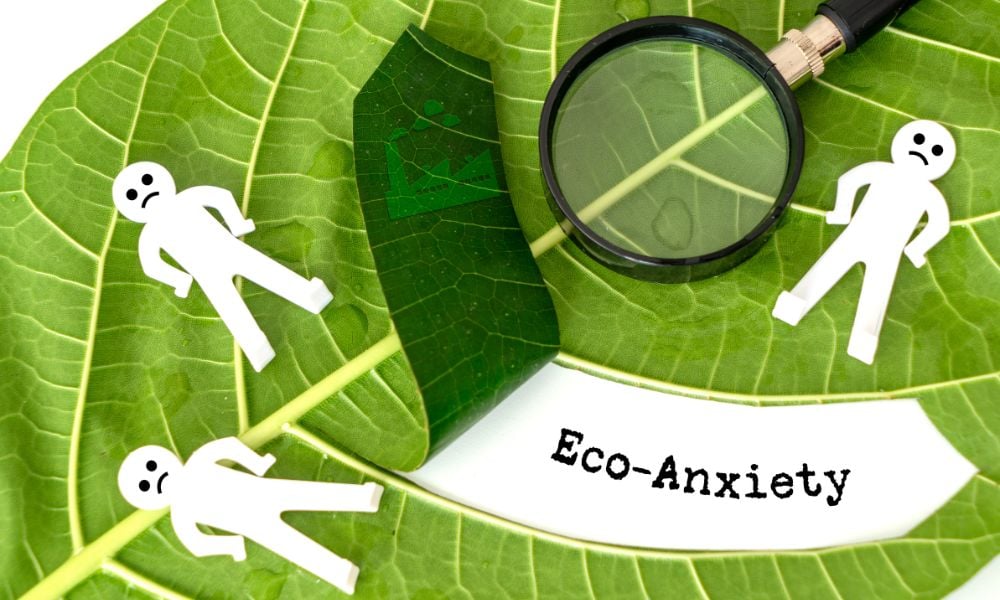
Nearly seven in 10 Canadians report moderate to high levels of concern about climate and the environment - and for younger workers, that number climbs higher still.
Those are the headline findings from a recent eco-anxiety report published by Beneva in partnership with researchers at Université Laval. They also come around the same time as much of Ontario dealt with poor air quality last week, due to smoke from wildfires that have been exacerbated in size and intensity by climate change. The findings raise pointed questions about what employers should be doing about a workforce that is, by the data, increasingly distressed.
Eco-anxiety leads to severe mental health, workplace issues
According to Christelle Lim-Severe, Beneva’s sustainability practice leader, the finding that stands out the most was the functional impact figure. Notably, one in five respondents said climate-related distress was interfering with concentration, sleep, or contributing to burnout. On its own, while 20 per cent might sound manageable, Lim-Severe frames it against a baseline that is already under pressure.
"When you think about mental health, one in three Canadians already experience some sort of anxiety or mental illness and it's the biggest source of lost productivity in days," she said, pointing to data from StatsCan. She also underscored that layering climate-specific distress on top of that existing burden makes the number harder to dismiss.
The data is sharper among younger Canadians. Concern levels in that group reached 73 per cent, and one in four reported functional impacts, a figure above the national average on both counts. Lim-Severe sees this as compounding a problem the group insurance sector is already tracking closely among younger workers, not introducing a new one.
What eco-anxiety looks like in practice
According to Lim-Severe, eco-anxiety had been gaining traction as a term across the insurance sector, but lacked the rigorous data needed to determine whether it constituted a genuine emerging risk or was simply a trending label.
That’s why Beneva partnered with a research chair in mental health and self-management at Université Laval to move past the shallow polling that typically defines the space.
"We didn't really have scientific data to see what it is,” she said. “Is it an emerging risk? Do we need to be worried about it from an insurance perspective or from a community perspective? Does it impact the functioning of people?”
Lim-Severe draws a distinction between everyday worry and eco-anxiety. The latter isn’t a fleeting concern but a persistent, layered distress tied to climate and environmental conditions.
“What we found in the study is a lot of people are not just worried about the present, like the air quality, but what's going to happen in the future if we don't do anything, especially for the future generation. That's the term for eco-anxiety. And it can be a set of emotions, whether it's sadness, concern, worry, or even guilt,” said Lim-Severe.
She breaks down climate risk into two dimensions: the physical and the psychological. The physical side is visible and immediate, like heat waves forcing construction and agricultural workers to endure dangerous conditions, wildfires degrading air quality, flooding damaging homes. But those direct exposures generate a secondary, less visible layer of mental strain. Workers in affected industries are not just coping with bodily discomfort; they are also processing existential questions about whether their livelihoods can withstand repeated disruption.
The psychological dimension compounds over time. Repeated exposure to climate events rewires how people respond to ordinary conditions. Someone whose basement has flooded three years running may begin to feel anxious at the mere forecast of rain. That feedback loop - lived experience breeding anticipatory dread - is the mechanism through which climate feeds anxiety.
Eco-anxiety data isn't all ‘doom and gloom’
"It's the physical, but it's also on the mental level of what if," Lim-Severe said, adding the research also captured something less expected.
“Just talking about eco-anxiety can give you anxiety but it's not all doom and gloom as most people that were surveyed also have a high level of hope and believe that we can tackle it,” she said. “There's still a window of intervention and prevention, and that's why we're talking about it today, because we want to take action so that these numbers don’t increase.”
To that end, she believes employers should act on that optimism rather than ignoring it, and channel this hope into tangible action. She believes giving workers a stake in climate action, whether through operational sustainability efforts or everyday behavioural shifts, converts passive worry into participation.
Lim-Severe frames the relationship between business and environment as reciprocal. Every organization affects the climate through its operations, and the climate, in turn, affects the organization, whether through supply chain disruption, flooding, wildfire response, or the operational strain of supporting affected customers. She highlighted how the insurance industry already illustrates this loop, noting insurers are working to decarbonize while simultaneously absorbing the costs of climate events on the claims side.
What can employers do to address eco-anxiety?
Still, she cautions against treating climate's workplace impact as uniform. For example, an office worker with air conditioning experiences a heat wave differently than a construction worker facing outdoor deadlines or a farm labourer whose income depends on being in the field. The exposure varies by sector, and employers need to assess how climate risk specifically touches their own operations and workforce rather than applying a generic response.
But the workplace impact that concerns Lim-Severe most is the one that does not show up on a balance sheet. Climate-related stress doesn’t stay at home when an employee clocks in. She compares it to financial stress - a well-documented driver of reduced productivity and absenteeism that no one expects workers to simply set aside at the office door.
For example, the employee anxious about air quality or worried about whether the next storm will flood their basement again carries that weight into every meeting and task. There is no clean separation between personal climate anxiety and professional performance, and employers who assume otherwise are misreading the problem.
The goal for employers is to shift from ad hoc responses to standing protocols that activate automatically when conditions demand it. On the adaptation side, she points to workplace flexibility as the most immediate lever. That kind of built-in responsiveness costs employers little but signals that the organization takes climate conditions seriously as a workplace factor rather than a personal inconvenience employees are expected to absorb.
Adaptation, though, is a stopgap as Lim-Severe is more emphatic about decarbonization as the real preventive measure. She argues every employer, regardless of industry, can identify and reduce its greenhouse gas emissions and involve its workforce in that process. Sustainable commuting programs, local procurement, and operational changes all serve a dual purpose: they reduce the organization's climate footprint while giving employees concrete ways to act on the concern the data shows they already feel.
"Yes, people are anxious, but what can you do? They have hope, so give them the agency to act and to do something," she said.