
Slim-margin drugmakers warn the two-year lead time could push them out of the US market entirely
Imported generic drugs, which account for about 90 percent of prescriptions filled in the US, will face tariffs of as much as 200 percent by 2029 under a phased plan US President Donald Trump announced this week.
Trump said on Truth Social on Tuesday that generic medicines entering the US would carry no tariff for two years from August 1, then face a 100 percent duty for one year, before the rate climbs to 200 percent, according to Reuters.
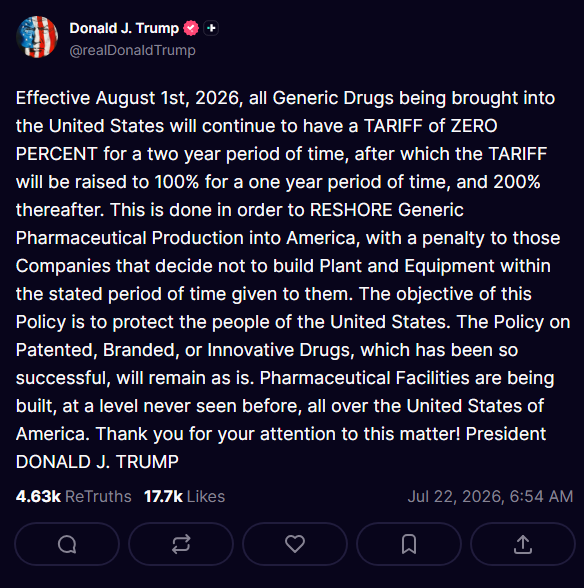
Source: Donald J. Trump, Truth Social (@realDonaldTrump), July 22, 2026
He framed the levy as a way to move production onshore.
"This is done in order to RESHORE Generic Pharmaceutical Production into America, with a penalty to those Companies that decide not to build Plant and Equipment within the stated period of time given to them," Trump wrote in the post.
According to the New York Times, the 100 percent rate takes effect in August 2028 and climbs to 200 percent in August 2029.
Whether those duties reach patients depends on how manufacturers respond, and the industry's economics leave little cushion.
Generic makers run on slim margins, so tariff costs are likely to flow through to buyers, Mariana Socal, an associate professor at the Johns Hopkins Bloomberg School of Public Health, told CBS News.
"Any changes to the tariff structure are likely to be passed through to the consumer," she said, though she added that competition and existing contracts could limit how quickly costs move.
The larger risk, several observers said, is supply.
Salil Kallianpur, an independent pharmaceutical consultant, told CNBC that steep duties on low-margin products could push commodity manufacturers out of the US market altogether.
"A 100-200% tariff on a product with single-digit margins is a market-exit notice," Kallianpur said.
Marta Wosińska, a senior fellow at the Brookings Institution's Center on Health Policy, voiced similar doubt to CBS News about the plan's core goal, saying, "a tariff can be part of a broader strategy, but is not going to by itself lead to onshoring."
Merith Basey, chief executive of Patients For Affordable Drugs, warned via Reuters that the measure could backfire for patients, saying tariffs "risk making lower-cost generic drugs millions of Americans rely on more expensive and harder to access."
Manufacturers argue the two-year runway is too short.
Building a domestic generic manufacturing base takes at least four to five years, Namit Joshi, chairman of India's Pharmaceuticals Export Promotion Council, told Indian news agency ANI, and producers on thin margins have few alternatives.
"We can only transfer that tariff. Or we can withdraw from the market," Joshi said, as reported by CNBC.
The industry's main US trade group struck a cautious note.
According to Reuters, the Association for Accessible Medicines is seeking details on the policy while pressing Washington to fix purchasing and reimbursement problems it says already discourage domestic production.
John Murphy III, the group's president and chief executive, said the sector has expanded its US footprint over the past two years but still faces structural hurdles.
Sandoz, one of the largest generic producers, told Reuters it would keep talking to policymakers, and its chief executive, Richard Saynor, said the company supports the goal of stronger domestic supply chains, according to CBS News.
The plan leaves generics exposed in a way branded medicines are not.
Trump said his separate policy on patented and branded drugs, which can reach 100 percent, stays unchanged, Reuters reported.
Generics had been exempt when the White House unveiled branded-drug duties earlier this year under a Section 232 national security investigation, the Financial Times noted, a framework left intact by the Supreme Court's February ruling that struck down other US tariffs, per CBS News.
Supply chains add to that exposure.
The US Food and Drug Administration estimates about 70 percent of generic drugs come from outside the country, according to the FT, with India the largest single supplier and China providing many active ingredients.
Indian pharmaceutical shares fell 1.3 percent after the announcement, Reuters reported.
The global generics market is worth nearly US$500bn, CNBC said.
Much still hinges on how the administration defines domestic manufacturing and writes the rules.
If the generic policy mirrors the branded framework, companies may only need to show US projects are under way rather than running before the deadline, Kallianpur told CNBC.
"What's new here isn't the direction, it's the specificity," he said.


