Canada is at the beginning of a global transformation, experts say at CPBI Forum
The post-World War II global order that shaped how Canadian institutional investors built portfolios is starting to unravel as Canada undergoes its transition into a New World Order.
The question now is whether Canada can turn that disruption into an advantage or whether it will remain a resource exporter watching from the sidelines while other nations rewrite the rules.
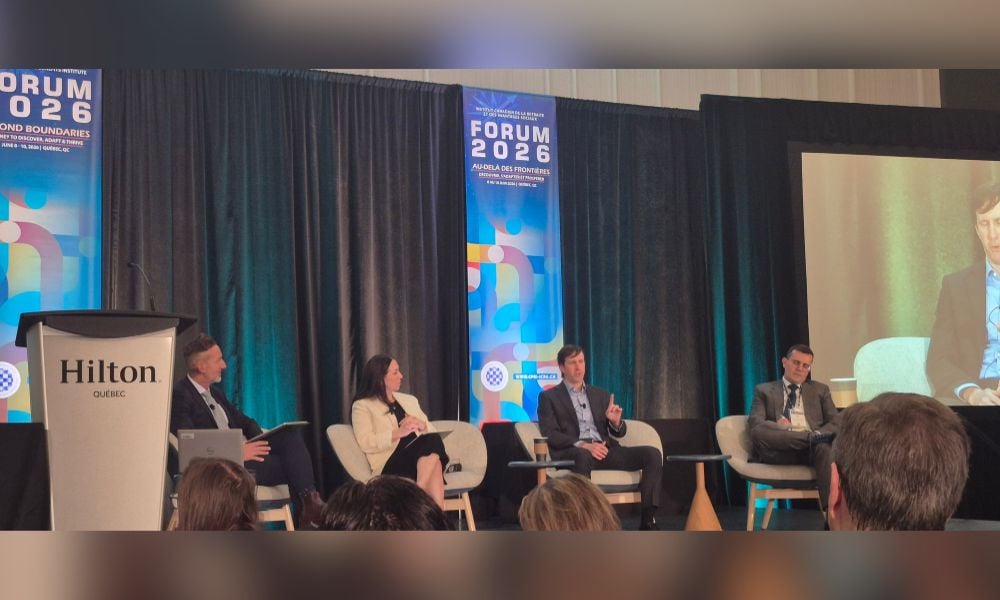
That was one of the several themes of a panel session at the Canadian Pension & Benefits Instite (CPBI)'s annual Forum on Wednesday as panelists outlined what a restructured global economy means for Canada and the fiduciaries managing its pension capital.
"Tectonic plates have been moving, they are shifting," said Eric Morin, global head of research at CIBC Global Asset Manangement. "There's a New World Order emerging. And one of the reasons for that is the ability and the willingness of the US to provide security to its allies globally.”
The world of Pax Americana, as Canada has known it, is over. Particularly as countries now face inelastic demand for military spending — investment that will happen regardless of interest rates.
"We are in a world where global military expenditure as a share of GDP will likely increase from about 2 per cent in most countries outside the US or in the developed world towards something that is 3, 4 or 5 per cent, that's massive," he added.
Grant Johnsey, head of market solutions, banking & markets, Americas, at Northern Trust agreed that the shift is structural, not cyclical, and pointed to the historical pattern underlying it.
"The US has actually always historically been isolationist," he said, tracing the line from George Washington's farewell address through American reluctance to enter the Second World War, noting the post-1945 outward-facing posture was the anomaly.
"Most of the world history has been regional pockets of power projection but we are going back to the second thing that we have all known in our lives is globalization. And that's also a historical anomaly," he said.
Meanwhile, the framework that has governed portfolio construction for decades like heavy US equity allocations, globalized supply chains and stable trade relationships, is losing its foundation.
Jayme Colosimo, Investment Director at Capital Group reframed deglobalization, suggesting the more useful concept is re-globalization.
"We would agree we could be moving into the scenario potentially of great powers where there could be more regional trading blocks. There could be a greater focus on being connected to allies in their hemisphere," she said, emphasizing that distinction matters for portfolio positioning.
Capital isn't retreating from the world, rather, it's reorganizing around different axes - security, proximity, and strategic alignment rather than pure cost efficiency.
Additionally, countries are now managing geopolitical risk the way portfolio managers manage financial risk — through diversification, redundancy, and a willingness to pay more for resilience. That dynamic creates duplication of infrastructure globally and, with it, a long runway for capital expenditure that supports both growth and inflation.
All three panelists were bullish that Canada is positioned to benefit, though none suggested it was automatic. Colosimo argued that in this environment, a country's investment case extends beyond its GDP print.
"Capital is not simply chasing the fastest growing country today," she said, noting that Canada's strategic relevance - energy assets, trusted institutions, North American geography - could matter more than headline growth numbers.
"You don't necessarily need to have this incredible high growth economic profile to start to see some real positive trends potentially for Canadian equities and the role that Canada can play in the investment narrative globally," she added.
Meanwhile, Johnsey brought data to support the case. He pointed to a roughly 30-year oscillation in relative market performance, with the cycle now turning away from the conditions that favoured US large-cap growth.
"We're going into a period where non US outperformed US, commodity cycle picks up, small caps tend to outperform and value does better," he said. "Those things to me are all very positive for Canada."
As for where US equity dominance is headed, Johnsey said, "If I go out 10 years from now, I have a hard time envisioning world market cap still being two-thirds of US equities.”
Still, the opportunity comes with a significant caveat as Johnsey underscored Canada needs more investable assets to buy, citing the need to develop natural resources, harness critical minerals, and reduce interprovincial trade barriers.
"If you really want to take what's ultimately a very small market in terms of size, but shape it to lead, you've got to innovate. I'm not seeing that happen in Canada," he said.
Morin zeroed in on two specific catalysts. Defence spending and natural resource investment will both attract foreign capital and generate opportunities across public and private markets.
"There will be foreign investment to meet that demand from abroad. There will be opportunities that could be good directly for the Canadian stock market, but also that they likely bring some important fees for private equity or private credit because there's certain investment that may not be public," he said.
As for Canada’s diversification strategy, Johnsey views Carney's outreach to Qatar, China, and Europe as a net positive but he notes that “it really comes back to building more of an investable universe here," he said, adding trade deals with partners like China — the world's largest importer of hydrocarbons — could help unlock that potential by creating new demand for Canadian assets that currently lack a global buyer.
Johnsey said he's watching closely how Canada positions itself on the world stage and noted that the current geopolitical tension has forced a degree of national unity and a serious rethinking of trade dependence on the US.
"If Canada seizes this opportunity in the right way with trade deals, leveraging its strong asset base, it could emerge as a much more wealthy and prosperous country," he said.
Moreover, if Canada succeeds in diversifying trade relationships and attracting capital, a stronger loonie notably creates its own complications for plans with large foreign allocations. Johnsey urged pension fiduciaries to move beyond binary hedging decisions.
"Instead of just a full hedge on or off, I would really start to think about what currency pairs are at a relative strength right now or relative weakness and where you want to have your hedging," he said.
While he sees capital repatriation as a real possibility, he underscored it’s not an imminent one. He identified two conditions that tend to drive money home - rising geopolitical fear and the availability of domestic assets worth buying.
Any escalation of geopolitical conflicts — whether in the Middle East or elsewhere — would push investors in any country, not just Canada, to pull capital back within their own borders, Johnsey suggests.
On the second, he acknowledged that Canada still faces political and structural hurdles in building out a deeper pool of investable opportunities. He singled out interprovincial trade barriers as a particular drag, noting that the friction of moving goods and capital between provinces undermines efforts to develop a domestic investment base that could absorb repatriated capital in a meaningful way.
As for whether plan sponsors should act now, Johnsey acknowledged that this is more of a “wait-and-see story.”
“Recognize that this is probably early stages of a larger transformation and shift," he said, noting the structural forces are real, but Canada's ability to convert its resource base and strategic position into investable market depth remains unproven.
"There's a lot of work to be done in this country to get to that point, but that is a strong possibility," he said. “I'm generally bullish overall on most of these markets. There’s going to be more volume, and I think there's definitely going to be a long trajectory to the global macro story that you'll see play out.”