Half the workforce cannot save each month as raises trail the cost of living

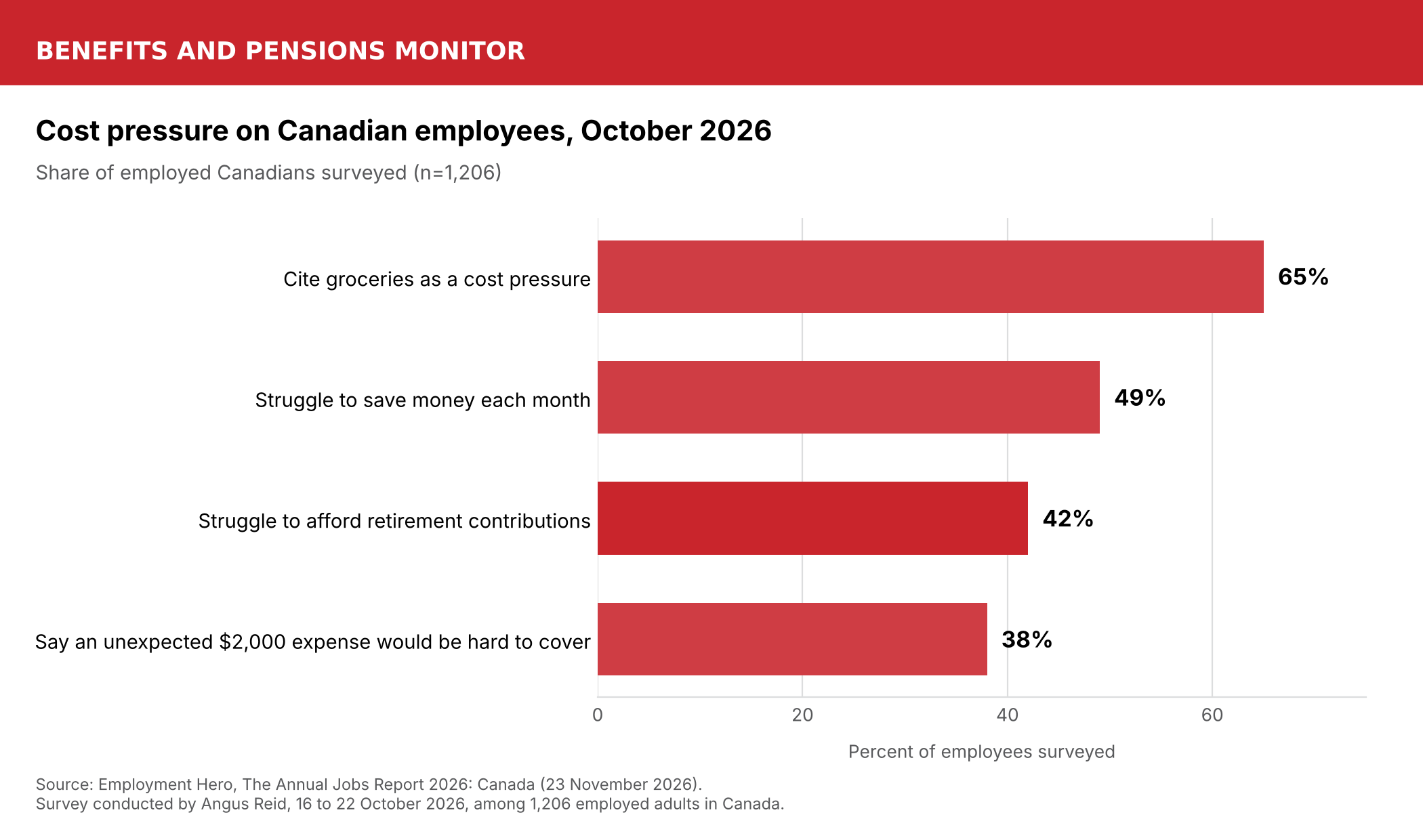
Forty-two percent of employed Canadians surveyed struggle to afford retirement contributions and 49 percent struggle to save money each month.
The Annual Jobs Report 2026 published by Employment Hero found groceries the most prevalent cost pressure, named by 65 percent of employees surveyed, against 53 percent in a parallel US survey of 2,015 workers that Focaldata conducted for Employment Hero in October.
Thirty-eight percent of Canadian respondents said an unexpected $2,000 expense would be hard to cover.
Forty-four percent of employees surveyed said a $100,000 salary in Canada is just enough to get by or no longer enough. Another 44 percent called it a solid middle-class income and 11 percent called it high.
BPM has reported separately that 37 percent of Canadians earning self-employment income delayed, stopped or reduced their retirement savings contributions in the past year.
Among employees who saw their earnings increase in the past year, 77 percent received 4 percent or less and 56 percent said the raise fell behind the cost of living.
The comparable US figure was 40 percent. Forty-eight percent of Canadian employees surveyed would need a raise of 15 percent or more to switch jobs.
One in four employees surveyed are still in a job they wanted to leave because changing feels too risky.
"I suspect two things are at play. The first is job hugging, a term used to denote when people stay put in their current roles because they see moving as too risky," wrote Lisa Cowie, global insight lead at Employment Hero, in the report.
Forty-two percent of employees surveyed think employees who stay with one employer end up worse off financially, the report found, against 12 percent who think they come out ahead.
Thirty-eight percent said they are not confident they could find something better and 33 percent said the job market is too tough.
Earlier BPM coverage of an Achievers Workforce Institute survey found employees want more pay but might stay for recognition.
Headcount across small and medium businesses on the Employment Hero platform grew by an average of 0.5 percent a month between March and June, then fell to an average of negative 0.5 percent a month from July to October.
Casual hours among non-fixed-term employees dropped 9.6 percent.
Median pay growth across those businesses reached about 4.2 percent over the year to October.
Statistics Canada's Labour Force Survey for October put average hourly wage growth among employees at 2.2 percent year over year, down from 4.7 percent in March.
Employment Hero noted its platform figures cover businesses on its platform rather than the whole Canadian labour market.
"Rising costs, economic uncertainty and rapid advances in technology are challenging Canadian businesses to do more with less," wrote Chris Pinkerton, managing director for Canada at Employment Hero, in the report's expert commentary.
A separate Employment Hero survey conducted by Focaldata in May found 56 percent of Canadian small and medium business owners and leaders had delayed or cancelled a hire in the past 12 months because of administrative capacity.
Fifty-four percent of employees surveyed say time outside work defines success, against 18 percent who say earning as much as possible does.
Fifty-one percent say their employer provides good training and 30 percent worry their skills are going out of date.
In separate BPM reporting, savings and retirement preparedness ranked as the top unprompted worry among Canadians with low confidence in their long-term finances, named by 17 percent of 835 respondents in that group.