Cortisol, dopamine, and decision fatigue are working against your benefits plan, says GreenShield’s Dr. Michael Mousseau
While Canadian employers and plan sponsors have poured money into benefits plans, from adding apps, expanding EAP coverage, layering in telemedicine, the returns have been underwhelming. Dr. Michael Mousseau, business development and mental health programs manager at GreenShield’s Calgary office, believes the problem doesn’t lie in these investments but rather what neuroscience research tells us about member behaviour.
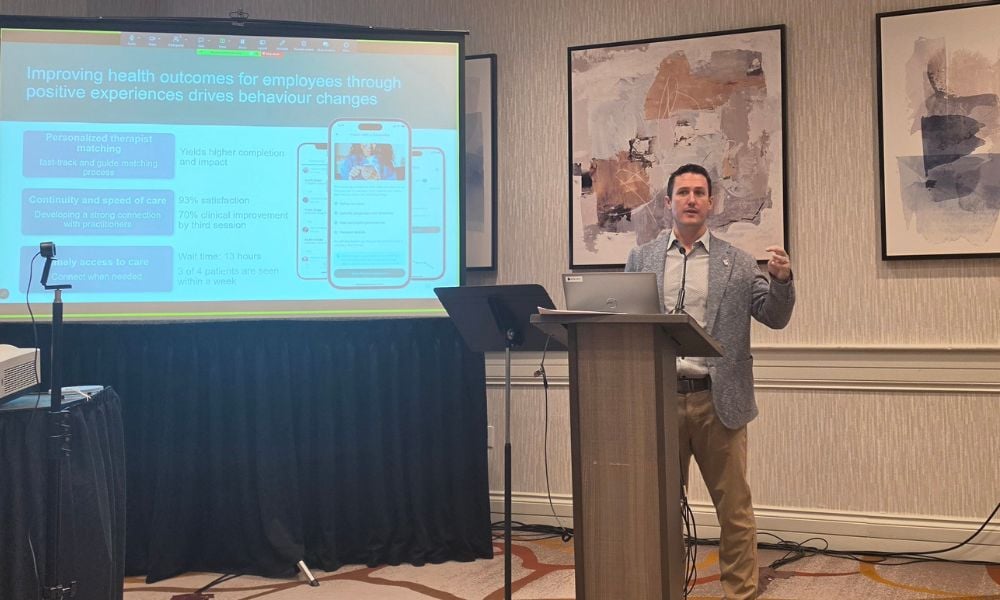
He outlined why a fully integrated benefits ecosystem is the fix during a session at the Canadian Pensions and Benefits Institute (CPBI) western regional conference in Kelowna on Wednesday.
How serotonin and cortisol shape employee engagement
According to Mousseau, serotonin - the chemical tied to feelings of happiness - responds to recalled experiences the same way it does to live ones. He highlighted an example to emphasize this point, noting a moment of gratitude recorded in a journal years ago can trigger the same neurochemical response when revisited.
"You can then also trick your brain and go back in your notes and think of that exact same situation five years later. The exact same amount of serotonin is flowing," said Mousseau, adding the implication is that positive mindset is not abstract self-help advice as it has a measurable biological mechanism.
"Our brains are very lazy. They're very energy sensitive," he said.
Moreover, employees are wired to stick with what they already know, whether that means submitting a claim the old way or calling an EAP the same way they always have. The brain favours the familiar path.
"Our habits are super deeply ingrained, but I'm here to say we've got to stick with it. We’ve got to keep going and drive this change for these employees because our brains are plastic. Neuroplasticity is this concept that we can reshape this, but it takes effort," he said.
Mousseau acknowledged the problem compounds when stress enters the picture. Mousseau explained that elevated cortisol - the stress hormone - suppresses higher-order thinking at the exact moment employees are trying to use benefits resources.
"When you are in these stressful situations, you're not thinking clearly, and thus all these amazing resources that are in front of you, you are blind to because you are just this one-track mind to get this thing done," he said.
"We have to ultimately think about this as a rewiring scenario here. We’re trying to disrupt and change an industry that's kind of been the same for 20+ years, right? We are trying to get employees to do something different. Now, is change easy? It's hard, it's very hard," he added.
He also flagged the cost of too many options, suggesting that volume of choice erodes executive function and degrades decision quality. For example, he compared it to how President Obama stripped minor decisions, like what to eat and wear off his daily agenda so he could focus on consequential ones.
He believes the same principle applies, noting when employees face a sprawl of disconnected tools and platforms, the cognitive burden pushes them toward avoidance. Mousseau said decisions get deferred, behaviours stay unchanged, and the resources employers paid for go unused.
The case for a single benefits ecosystem
His answer is full integration, one that includes a single ecosystem where employees aren’t retelling their stories, bouncing between disconnected vendors, and making unnecessary decisions about where to go next. He sketched out what that looks like in practice: an employee completes a health risk assessment, gets flagged for a concern, picks their own therapist, and that therapist - because they can see what else is in the ecosystem - routes them to a nurse or dietitian without a second intake.
"That's integrated team-based care. That is ultimately really helping the person to stay motivated upon their health journey," he said, noting the contrast between traditional models.
"What we're seeing in these disconnected systems is that it's fragmented. There's limited ROI. A lot of times you're trying to access some of these systems but you're being rejected out of the system because maybe you have a preexisting condition or you're being referred out to more long-term therapy. There really shouldn't be a difference between short and long-term therapy. Employers need to put themselves in their employees’ shoes," Mousseau added.
The dollar figure on integration
To make the case, Mousseau walked through a case study from one of GreenShield's health outcomes reports to put a dollar figure on integration. A 5,000-employee organization added a fully integrated EAP to its existing benefits plan at a cost of roughly $31 per employee per year - about $160,000 annually.
Before integration, the organization was spending $90 per employee per year on paramedical costs and $109 on mental health-related drug costs. Two years after moving to an integrated model, paramedical costs dropped 58 per cent and drug costs also declined, producing gross annual savings of approximately $345,000.
After subtracting the EAP expenditure, the net savings came to $186,000 - a return of $1.50 for every dollar invested. He stressed that the savings came not from adding more resources but from consolidating existing ones into a single access point where employees could reach care faster, stay with the same counsellor, and avoid the re-intake loops that drive abandonment.
"We're investing in these mental health supports that are actually creating some tangible impact on people, but also financially on the organization as well," he said.
To that end, Mousseau argued that benefits systems need to work with the brain's reward circuitry, not against it, particularly as dopamine drives motivation through immediate, tangible feedback. He suggests platforms that track incremental progress and deliver small, visible changes stand a better chance of keeping people engaged than those that hand over a static plan and walk away.
"The question shouldn't be how we get people into a healthcare system. It's how do we make it easier for them to stay connected to the right care and keep them motivated to keep going?" said Mousseau. "It's a whole different kind of philosophy. We have to start putting that person at the center of this journey. We need to make sure that these systems talk to each other because if we do this, we start to improve the health outcomes."