Report provides breakdown of HR salary ranges for variety of roles across Canada

Canadian employers are budgeting for moderate base salary increases of 3.1% to 3.3% on average in 2027, while concentrating compensation dollars on specialized and strategic roles, according to Randstad Canada.
Those increases are the same as the average increases actually granted in 2026.
According to the company's Salary Guide, only 4% of Canadian companies plan flat, across-the-board raises, with merit pools instead being directed to high-performing specialists and key skill gaps.
Randstad breaks the national average down by province, with Alberta and British Columbia leading the way at 3.4%:
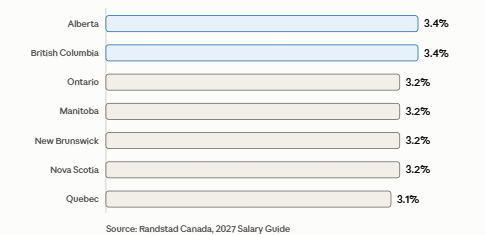
Randstad's findings are consistent with other predictions for the 2027 compensation landscape, including Normandin Beaudry, which reported average salary increases of 3.1%, and Mercer Canada, a business of Marsh, which found that employers plan to budget an average merit increase of 3.0% and total salary increases of 3.2% in 2027.
Mid-range salaries for HR roles
In GTA’s biggest market, several senior roles stand out in 2027, with salaries reaching well into the six figures:
- AI governance specialist: up to $307,100
- AI agent architect: up to $221,300
- Construction superintendent: up to $172,200
- Millwright: up to $56.91/hour
Here’s a range chart of the 2027 mid-range salaries by role and city for three HR roles:
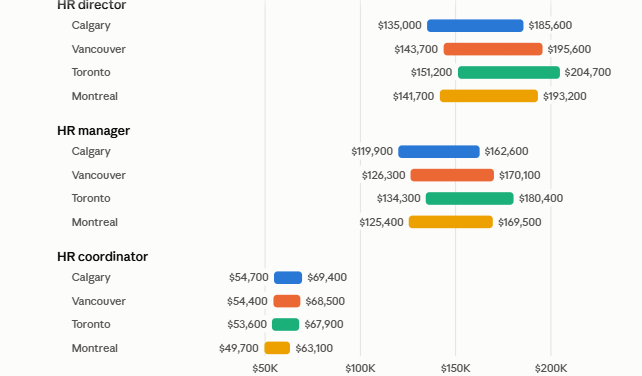
HR roles in Canada. are set to see smaller salary gains for new hires in 2027 than the in-demand positions in other professional fields, according to a separate survey from Robert Half.
Pay transparency drives structural adjustments
Randstad reports that expanding provincial pay transparency laws, including British Columbia's Pay Transparency Act and Ontario legislation, are prompting employers to rework their compensation frameworks.
To ease wage compression between long-serving employees and new hires, and to ensure advertised salary ranges can withstand public scrutiny, employers are allocating 2.0% to 2.6% of payroll to structural pay-band adjustments rather than uniform merit raises, it states.
More than half of Canadian job postings now include wage or salary information — 57 per cent as of June 2026, up from roughly one in five postings six years ago, according to an earlier report.
Business growth predictions
According to the Randstad guide, 98% of Canadian employers say they are confident about business growth heading into 2027, compared with 49% of Canadian workers.
Randstad attributes the gap to a broader economic transition. It says real GDP growth is projected to recover to 1.8% in 2027, while national unemployment continues to fluctuate between 6.5% and 7.0%, which the guide describes as a sign of persistent economic slack.
It also cites elevated interest rates, U.S. tariff adjustments and slower population growth as factors that have created excess supply in the economy, prompting employers to shift from mass hiring toward operational efficiency and skills-first workforce planning. The release does not include these economic figures.
Randstad says that businesses face squeezed margins from U.S. tariffs averaging 5% on exports and a Canadian dollar worth roughly 71 U.S. cents, which raises import costs.