TD names three conditions, and says deployment across firms remains gradual and uneven
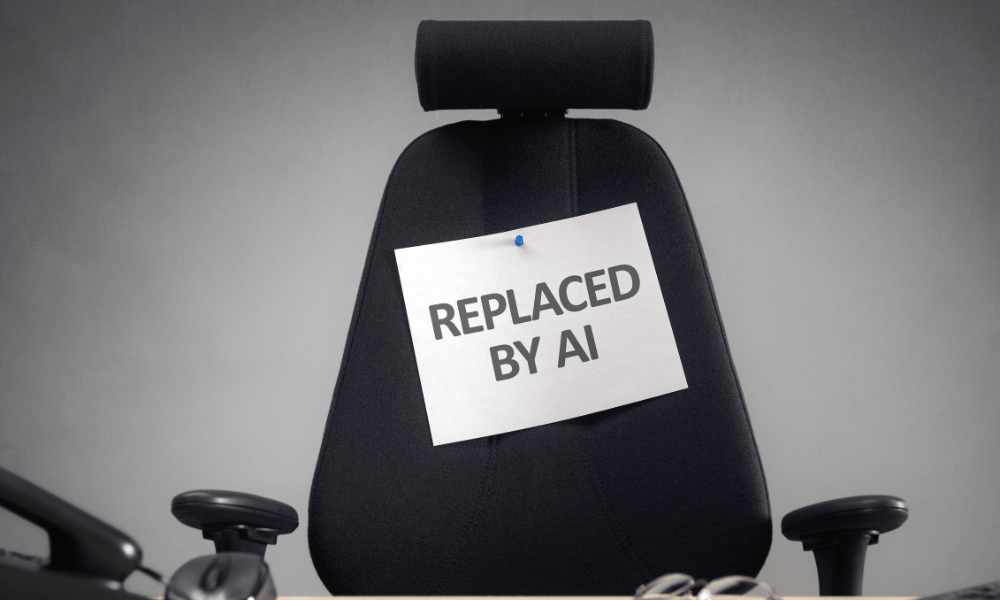
A large-scale AI-driven displacement of workers would require technology that performs tasks reliably, costs low enough to make automation economically attractive, and rapid adoption across firms.
According to a report published by TD Economics, those conditions have yet to align.
Economists Rannella Billy-Ochieng’ and Thomas Feltmate wrote that fully autonomous performance remains limited, that far fewer tasks are economically viable to automate than are technically exposed, and that deployment across firms remains gradual and uneven.
The AI job apocalypse, the report said, “remains a risk scenario, not the base case.”
Across the United States, roughly half of all jobs have at least a quarter of their tasks exposed to AI technologies, the report said, drawing on US Bureau of Labor Statistics data and research covering more than 18,000 workplace tasks.
Research cited by TD estimates that less than 2 percent of jobs contain more than half of their tasks that could be fully automated using AI combined with existing software tools.
MIT researchers cited in the same report found that while 36 percent of occupations contained at least one technically exposed task, only 8 percent contained a task that appeared economically viable to automate at scale.
Around one-fifth of US businesses recently reported using AI technologies, according to the Business Trends and Outlook Survey cited by TD.
Nearly half of workers have used AI at least once and 13 percent report using it daily, figures TD drew from the GenAI Adoption Tracker produced by the Harvard Project on Workforce.
Under TD’s two scenarios, the US unemployment rate rises by 0.7 and 1.4 percentage points respectively above its base case by the early 2030s, with annual productivity lifted by 0.5 percentage points and a full percentage point by 2031.
The economists noted that a recession occurring alongside rapid AI adoption could produce greater employment losses.
The Canadian Press reported that Ottawa's national AI strategy, released in June, said less than 15 percent of Canadian businesses use AI to produce goods or services.
The strategy said Canada also ranks behind many others in AI training and literacy and in public trust in AI systems.
According to a global study from the IBM Institute for Business Value, 68 percent of Canadian CHROs identify the ability to supervise, validate, and override AI outputs as the workforce's most essential skill, while 29 percent of Canadian employees rank judgement as important.
The study surveyed 1,500 CHROs and senior executives responsible for workforce strategy between April and June, and 8,800 full-time employees in June.
Skills erosion concerns 62 percent of Canadian employees, and 69 percent of those who are concerned say AI has already begun to erode at least some of their skills.
It was cited as a top concern by 45 percent of Canadian CHROs.
“Critical thinking, judgement and the ability to challenge AI-generated outputs will become increasingly important,” said Brandon-Jo Mouna, director of human resources at IBM Canada, in the study release.
Globally, organizations that clearly define workflows as human-led, AI-assisted or AI-executed achieve 18 percent risk reduction and 20 percent quality improvement.
Where judgement is built into how work is done, 62 percent of CHROs report growing employee confidence in AI-enabled decisions, against 57 percent reporting declining confidence where it is not.
Thirty-seven percent of Canadian organizations do not involve the CHRO when AI strategy is being defined.
Thirty-nine percent of Canadian employees report that blame falls on them when something goes wrong with AI, and 72 percent of Canadian CHROs say they struggle to coordinate consistently across the C-suite.
Limited or no use of AI inside the HR function was reported by 63 percent of Canadian organizations.
Canadian CHROs rated HR’s capabilities lowest in AI literacy across the team at 23 percent, AI performance measurement at 20 percent, and change management for AI adoption at 24 percent.
Eighty-seven percent believe AI adoption creates “invisible” work for employees, and 45 percent say AI productivity gains are primarily reinvested for innovation or reskilling.