From QR codes to swag and personas, three plan sponsors outline how they’re communicating benefits for employee engagement
While most plan members don't think about their benefits until they really need them, that persistent gap between coverage and awareness is pushing plan sponsors to let go of email blasts and benefits booklets in favour of branded, multi-channel communication strategies that meet employees where they are, in-office or at home.
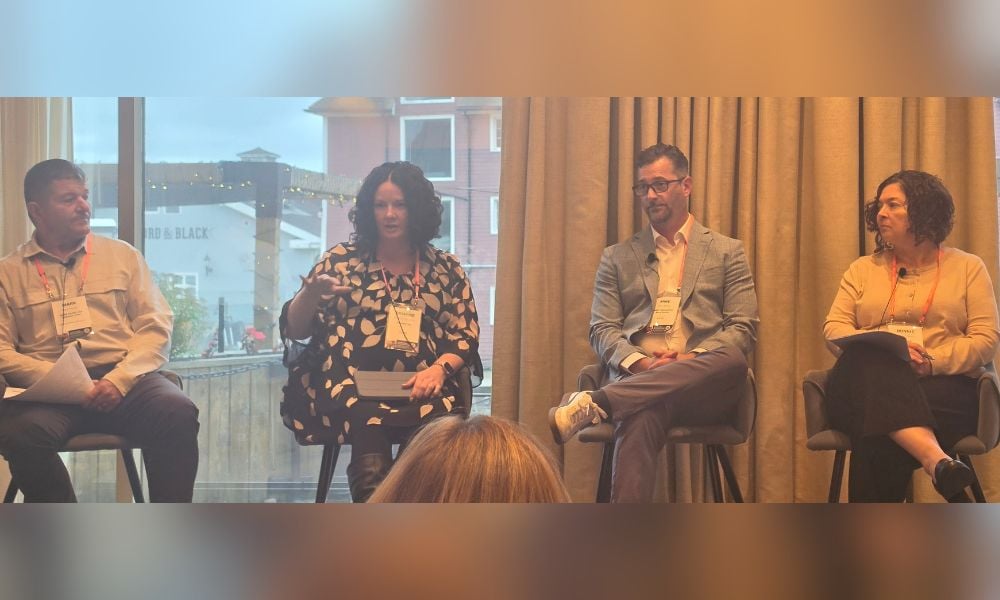
At the October 2026 Canadian Pensions and Benefits Institute (CPBI) Atlantic conference, held last week in Halifax, several plan sponsors highlighted what they're doing differently. While many have implemented new tech like QR codes or branded swag for employees to show off at work, the common dilemma all three face is that traditional benefits communication has failed. They suggest the fix demands more than a new template.
Brianne Bampton, director of compensation, total rewards, and workforce services at Halifax-based Shannex Incorporated, manages benefits across roughly 8,100 employees, 75 per cent of whom are unionized under more than 50 collective agreements. She acknowledged her team's turning point came when they stopped treating communication as an afterthought.
"The biggest change we've made over the last four or five years is developing a real strategy around total rewards," she said, adding the team created a brand to tie disparate programs together, from return-to-work supports, paid time off and pharmacy benefits all under one umbrella. "People didn't connect the dots on what total rewards is in relation to benefits.”
Moreover, the strategy only gained traction after Bampton made an unconventional hiring decision. When she was asked to fill a group benefits manager role, she recruited a communications specialist instead.
"I can manage the business plan. It takes a lot of effort for me to sit down and write great communications. It's too tedious for me, it's just not my forte, so I hired for my weakness," she added.
Meanwhile, Bonnie Carson, director of employee wellbeing and total rewards at Fredericton-based New Brunswick Power Corporation, faces a similar challenge across a 3,300-person workforce that’s 93 per cent unionized and spread between offices, generating stations, and field crews.
"Most of our employees do not read emails, so getting that communication out to them is quite difficult," she said, noting that the approach at NB Power borrows from the utility's strongest cultural asset: safety.
That’s why every meeting across the organization opens with a safety message, and her team is working to give benefits and well-being the same standing. The recently launched well-being strategy, called “Better Well,” is built around four foundations: mind, body, life, and work, with all benefits mapped into that framework.
Branding benefits like products, not policies
“We use QR codes. We use videos on the screen. We use email. We have SharePoint sites. We have boots on the ground. We go to the employees out in the field and try to educate as much as we can. We try to equip our leaders with as much information as they can, because it allows employees to trust their leaders or their supervisors,” she said.
Moreover, NB Power recently began sending calendar invitations for benefits sessions rather than relying on passive announcements.
"Before we maybe had 40 or 50 people show up, now we're getting over 200 because we're pushing the meeting and they accept. It's in their calendar," she said.
Bampton's team uses QR codes as both a delivery mechanism and a measurement tool. By assigning a unique code to each channel, like posters, digital screens or table tents in staff lunchrooms, they can track exactly where engagement is coming from.
"You can have the same communication go out on five channels, and you just create a different QR code for each channel. And now you can measure who actually engaged with each type of channel," she said, adding the table tents, modelled on the bar menu cards you'd find at a restaurant, rotate monthly and have proven effective at catching employees during downtime.
Additionally, Bampton’s team uses personas to shape benefits messaging, drawing on pharmacy utilization data and workforce demographics to build content around what specific employee profiles need. For example, a 25-year-old frontline worker gets different messaging than a 50-year-old approaching perimenopause.
"When we market our benefit program to our staff, we will often put ourselves in their shoes and build our messaging from there," she said.
Why branded swag is the underrated tool
Branded swag has also been an underrated tool for building recognition for Bampton but only when the items are worth keeping. Her team secured partner funding to brand 50 Yeti tumblers with the total rewards logo and raffled them off, putting the brand into employees' daily routines without spending money on glossy mailers or pamphlets that get tossed.
She acknowledged she’s also experimented with biodegradable dishcloths printed with the branding, reasoning that something useful enough to bring home extends the brand's reach beyond the workplace.
“We don't waste money on glossy mailers, we don't like pamphlets. Everyone's going to toss away the cheap swag, but if you buy meaningful swag, they’re not going to toss that,” she said.
Mike White, director of group benefits solutions at Health Association Nova Scotia, based in Bedford, agreed that branding is a lever too few plan sponsors pull. His organization rebranded its long-term disability plan from the cumbersome "Nova Scotia Association of Health Organizations Long-Term Disability Client Trust" to PATH to Health, aligning it with an early intervention program already well-known across its membership.
"The leap forward for us in terms of accessibility and imagery and co-branding has been really significant," he said.
White's team operates a multi-employer plan serving more than 300 organizations across healthcare, home care, and early childhood education. But he acknowledged how that structure can complicate outreach, particularly as employer receptiveness varies, and his staff sometimes shows up uninvited.
"It's really just a tireless approach of trying to get in the door. Not taking no for an answer, pivoting to different dates or different opportunities," he said.
Turning multi-generational challenges into opportunities
With an 83 per cent female healthcare workforce and a concentration of women in the 40-to-50 age range, Bampton’s team has leaned into themes around chronic disease, menopause, and perimenopause and packaging complementary plan features together rather than promoting them in isolation.
Still, White acknowledged there is no clean solution to multi-generational communication. His plan's membership is 86 per cent female and skews toward healthcare workers and early childhood educators, so his team is also tracking demographic trends - women's health, perimenopause and menopause supports - and turning them into targeted content. But the retiree segment still wants a letter in the mail and a phone number to call.
"We have to maintain that human contact there. We can't completely pivot to something that's impersonal and won't work," he said.
For Bampton, the generational split plays out at Shannex in a specific way. While younger employees respond well to the digital channels her team has built out, the older workforce, those approaching retirement, still require hands-on support.
“We do have that on-site workforce coordinator who basically becomes their best friend. They will pop in and out of that office all the time. That becomes the person that can support them. They will actually hold their hand a little bit and walk them through the process with a little bit of patience,” she said.