Cost controls, insurer review processes and prior authorization stretch private drug plan timelines, even as Ontario program accelerates public access
Despite private drug plans having long marketed themselves as the faster route to new medicines, new data from Innovative Medicines Canada and IQVIA suggests that advantage is shrinking, causing public programs to catch up.
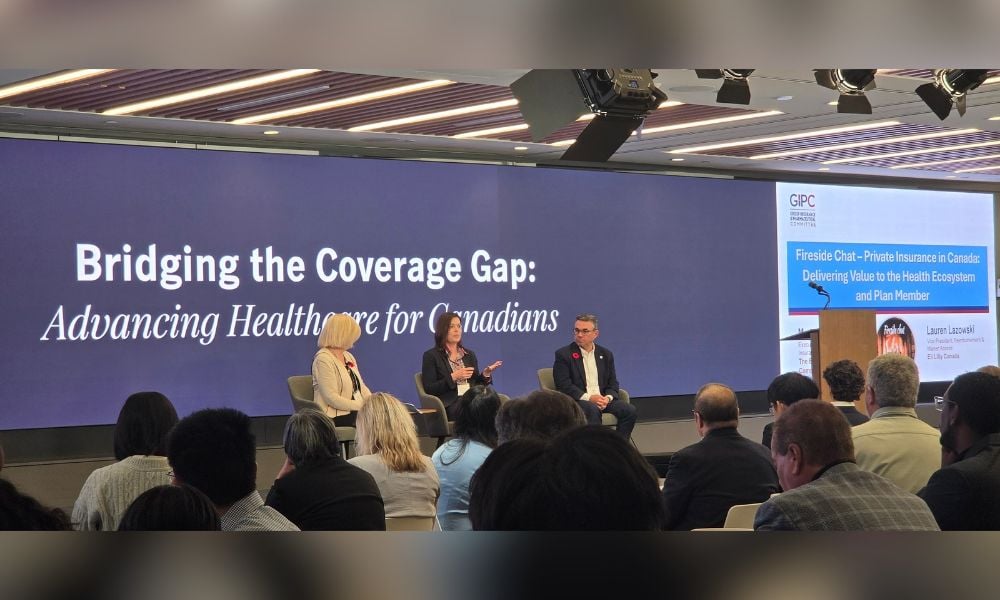
As Joe Farago, executive director of market access at Innovative Medicines Canada in Ottawa, told attendees at the Group Insurance Pharmaceutical Committee (GiPC) conference in November 2026, it now takes 465 days for 50 per cent of private plan members to access a newly approved drug.
Meanwhile, to reach 30 per cent coverage, the wait is 231 days.
“You’ll probably knock off about three to five weeks because of the process, but that’s a lot longer than it was six, seven years ago,” Farago said. “Those numbers are owned by pharmaceutical manufacturers and by the insurers.”
The data comes from a 2025 Cost Drivers Report Innovative Medicines Canada conducted with IQVIA, which maintains the only national private claims database in Canada, covering roughly 80 per cent of claims.
Innovative Medicines Canada publishes annual cost driver data alongside IQVIA that tracks annualized growth in private plan drug spend, which stood at 6.2 per cent in 2025 with a compound annual rate of 5.8 per cent over the period studied.
A shared responsibility
According to Farago, those numbers represent time to access for individual plan members rather than just when a drug is listed on a formulary. The delay captures submission timelines, product listing agreement negotiations and internal insurer review processes.
Farago underscored the slowdown is a shared responsibility between manufacturers and insurers, and both sides need to collaborate to bring access times down.
Because Canada is a smaller market and serves as a reference country for US pricing, pharmaceutical companies now face a difficult calculation. Launching a drug in Canada at a lower price risk dragging down the price in the US, which accounts for 60 to 70 per cent of global pharmaceutical profits. That makes some companies reluctant to launch here at all.
“There are about 23 medications that are not coming to Canada. Some oncology, important drugs, some rare disease, they’re not coming here,” Farago said, noting that there’s still another 20 to 30 products that are queued for processing and will be delayed.
For the drugs that do come to Canada, Farago said some may come at the same price they would have carried before, while others may arrive at a higher price to stay competitive with the US market.
“I can’t tell you which ones or when things are going to be impacted, but that’s MFN,” said Farago, pointing to the US’ Most-Favored-Nation, drug policy under US President Donald Trump. “We’re dealing with that globally and we’re working with the public programs which are going to be impacted by that as well.”
Ontario FAST program accelerates access
Moreover, Farago emphasized how most people working in the private market aren’t fully aware of what public programs are doing to speed up drug access. The public numbers, while still worse overall, are improving.
He pointed to Ontario’s Funding Accelerated for Specific Treatments (FAST) program, launched in October 2025, which reverses the traditional sequence by listing drugs on the public formulary before price negotiations with the pan-Canadian Pharmaceutical Alliance (pCPA) are complete.
Ten products have been listed through the program so far, and the province says it has cut access times by 60 per cent for life-saving therapies. Once a drug is listed, the pCPA negotiates the final price and any discounts flow back to the province.
The private market still covers roughly 15,000 drug products compared with about 7,500 on Ontario’s public formulary, Farago noted. But if the speed gap narrows further, the value argument becomes harder to sustain.
“The question there is, can the private market be innovative? Well, of course we can. We’re working with a lot of insurers to look at where this pathway, when a manufacturer submits a drug to the plan member, where we’re trying to see if we can speed things up so that plan members have faster access?” said Farago.
Plan design pressures compound the problem
Marc Avaria, executive vice-president of the group insurance division at Equitable, said insurers are trying to streamline their prior authorization processes but acknowledged the sector is not always delivering the latest treatments quickly.
“If the right drug means the latest drug, the latest science, then I would say no. I don’t think we’re always doing that,” Avaria said. “I think we’re trying to, and I think it’s a good assessment of how long it takes to actually get each other through.”
Avaria said Equitable is reviewing prior authorization approvals to determine which drugs are routinely approved and could be automated, reducing administrative burden on physicians and plan members alike.
“It’s an incredibly difficult and complex process that requires a multitude of different environments and agendas to come together. We have not gone to the macro effort. From what we can control, we’re trying to make sure that we speed up the prior authorization process for urgent situations so that the member gets an answer appropriately and doesn’t have to sit and wait,” said Avaria.
Lauren Lazowski, vice-president of reimbursement and market access at Eli Lilly Canada, said prior authorization processes frequently take more than four weeks and involve multiple rounds of communication back and forth. Physicians don’t fully understand the criteria and most plan members end up eventually being approved.
However, finding a solution requires fixing a larger problem first. Both Avaria and Lazowski underscored how Canada’s health data infrastructure is very fragmented, particularly as electronic medical record systems don’t communicate with each other, coordination of benefits is hard to understand, and pricing information isn’t shared openly across stakeholders.
Avaria said that while communication between pharmaceutical companies and insurers has improved, assessments still take too long.
If this fragmentation isn’t addressed, Lazowski made it clear that the industry won’t make plans truly sustainable without compromising healthcare access in the process.
“We’re adding a lot of administrative barriers and hurdles, not only for the insurance themselves, for the plan member, but think about the healthcare provider who now is filling in the forms,” Lazowski said.
What sustainable plan design looks like
The foundation of sustainable plan design comes down to better data, said Lazowski. Right now, the industry relies on broad utilization figures to understand what’s working and where money’s going, but that level of detail isn’t enough to make precise decisions about what individual plan sponsors actually need, she said.
With access to richer data, like real-world outcomes and shared information across electronic medical records, plan sponsors could make targeted decisions about what to fund and what to remove, rather than defaulting to blunt instruments like caps and maximums that restrict access across the board.
“Right now, we want broad strokes,” Lazowski said, pointing to plan caps and maximums “but then that means individuals aren’t getting what they need. The foundation really starts with building up data-driven decision-making.”
Ultimately, both speakers argued the industry needs to redefine how it measures the value of private drug coverage, moving beyond cost per claim toward metrics tied to plan member health, workforce productivity and reduced disability claims.
Farago agreed, emphasizing that while new therapies are more expensive, and plan sponsors are focused on cost sustainability, the industry needs to move away from that framing.
“Faster access is actually worth paying for, especially if you’re waiting for one of those medicines, as is having the right drug at the right time,” said Farago. “As a sector, we need to shift people’s thinking from ‘What’s the ROI in terms of financial terms?’ to ‘What’s the ROI for plan member health and outcomes?"