The Alberta referendum is, at its core, an exercise in microscopic politics, writes Randy Bauslaugh
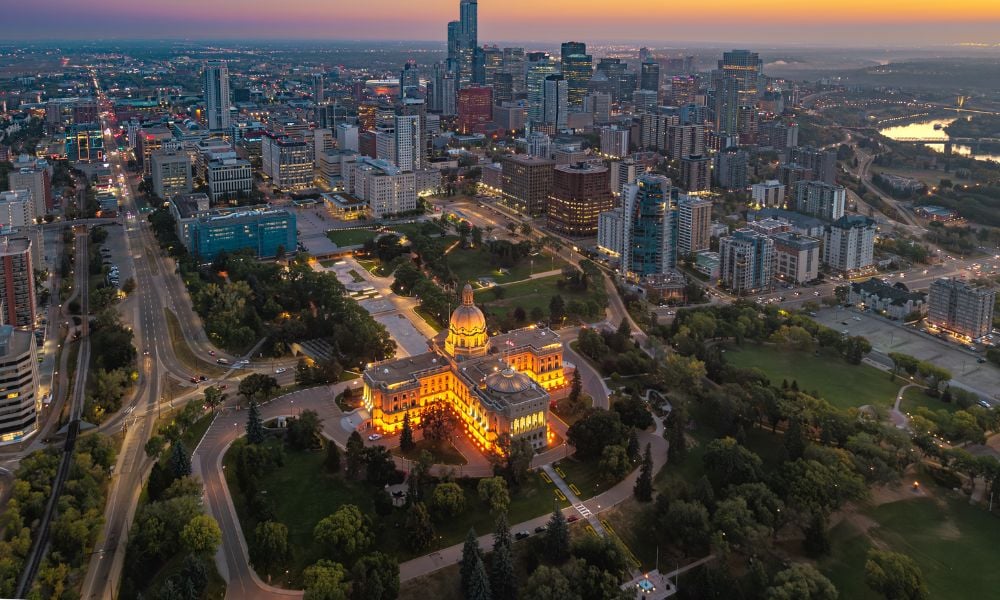
The Alberta referendum is, at its core, an exercise in microscopic politics: a magnifying glass held so close to one province’s frustrations that it obscures the larger picture of how Canada actually works. It creates uncertainty without solving anything, and it risks weakening the very systems that make our national economy function.
The debate has been dominated by a narrow view of the world. Many proponents seem uninformed about the broader implications or how economic and geopolitical forces actually operate. You cannot manage climate risk, global commodity volatility, or continental security at the level of a family farm or a single corporation. These are system-level risks. They require national coordination, shared investment, and a recognition that Canada’s prosperity depends on acting collectively, not atomizing ourselves.
The referendum also echoes a familiar problem in Canada’s retirement system: the belief that smaller, isolated structures can outperform coordinated national ones. As a pension lawyer, I see this every day. Canada has more than 16,000 registered pension plans. It’s an astonishing number for a country of our size. Instead of pooling retirement savings in large, efficient, multi-employer defined benefit plans that share risk and reliably produce twice as much retirement income for the same cost, we continue to lean into single-employer plans and RRSP-style individual accounts. Employers and individuals insist on having “their own plan,” largely because the experts -- consultants and insurers -- have a vested profit interest in keeping things small, fragmented, and inefficient.
The result is a retirement system that costs more, delivers less, and leaves people and employers exposed to risks they cannot possibly manage on their own; risks they could avoid while producing twice as much retirement income for the same cost. It also sounds exactly like the place Alberta aspires to by pulling out of the Canada Pension Plan (CPP), seeking a one-time opportunistic uptick until actuarial reality catches up and systemic economic inefficiency takes over.
Canada is far more interconnected, culturally, economically, and linguistically, than the referendum conversation acknowledges. Years ago, at a tourist attraction near Kamouraska, Quebec, a local was astonished that my family spoke French. When I explained that my children attended a French public school in Toronto, he was genuinely shocked. He didn’t know that half of New Brunswickers are francophones, or that most of Northern Ontario is francophone, or that there are material pockets of francophone communities in Manitoba, Southern Ontario, and virtually every province.
That moment has stayed with me because it revealed how easy it is to mistake one’s own local experience for the national reality. The Alberta referendum suffers from the same problem. It treats Canada as a collection of isolated silos rather than a deeply interdependent federation whose prosperity depends on shared infrastructure, shared labour mobility, shared markets, and shared risk management, as well as a shared culture.
Economically, the referendum’s logic is backwards. I’m a capitalist who doesn’t object to progressive taxation because I believe that social investment is essential to making capitalism thrive. A strong economy needs tax dollars to invest in a healthy, educated, and secure workforce, and to build the essential infrastructure, like water, energy, and transportation, that allows everything else to function. It also needs programs and rules that ensure opportunity isn’t distorted by irrational or discriminatory bias. Social programs and human rights protections aren’t ideological "woke" add-ons; they’re the most efficient way to ensure everyone can participate fully. That’s how you get growth, stability, and shared prosperity.
The referendum imagines that prosperity comes from pulling apart rather than working together. It’s a bit like staging a fire drill when there’s no material risk or possibility of fire. Everyone runs around, alarms go off, and when it’s over, we’re no closer to fixing the real issues that matter to Canadians or Albertans. And perhaps, charitably, this is meant as a negotiating strategy. But it is one taken from the bully’s guide to getting your way. A tactic that almost never works. At best, it alienates others; at worst, it creates distrust and makes genuine cooperation harder to achieve.
Canada works best when it remembers that its strength lies not in fragmentation, but in the broad, interconnected reality of who we are. The referendum forgets that. And that is why it is a distraction from the real work that needs doing.
Randy Bauslaugh is a semi-retired pensions and benefits lawyer with ongoing corporate board responsibilities. He has spent decades advising major employers, boards, and plan sponsors across Canada on pension design, governance, and structural risk management.