Behavioural economists at Deloitte explain why plan members don't save enough and what psychological tools sponsors can use to change that
Having access to a well-designed retirement plan doesn’t always guarantee member participation. Despite investing in information-heavy communication strategies, plan members miss the behavioural triggers that govern how financial decisions are made.
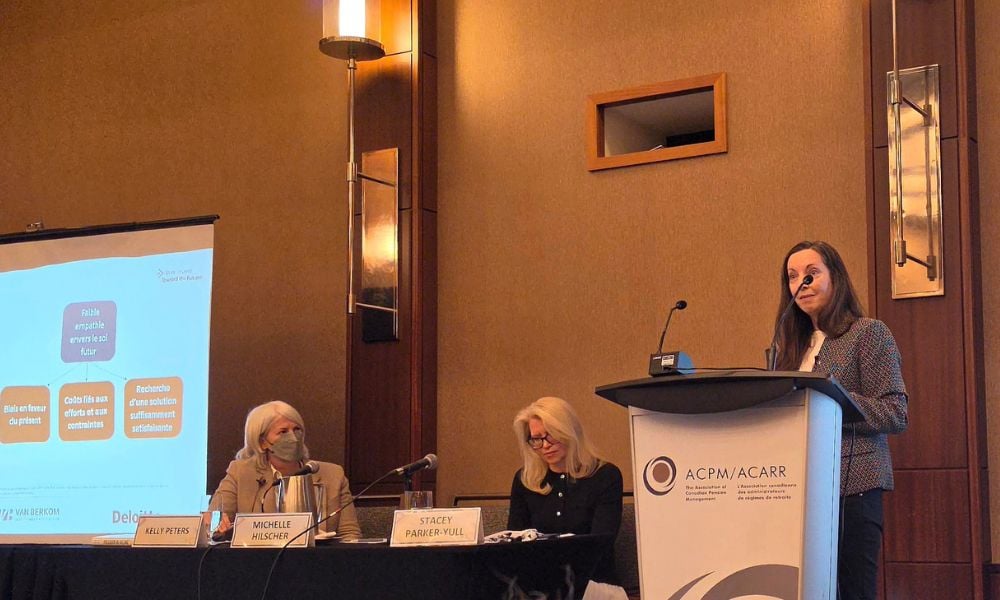
One of the opening sessions at the Association of Canadian Pension Management (ACPM) on Wednesday made clear that plan members aren’t failing to engage with plans because they lack intelligence. Rather, they’re operating under real constraints on their time, energy, and attention that make exhaustive financial analysis unrealistic, said Kelly Peters, director of behavioural economics at Deloitte Canada.
"Humans are not rational calculating machines," she said. "We are boundedly rational. Bounded as in limited. Rationality is limited. Bounded rationality is a more sophisticated way to explain and maybe help understand why people are doing these."
Testing what drives savings behaviour
According to Peters, rather than process every piece of plan information placed in front of them, members default to heuristics - mental shortcuts shaped by what peers are doing, what feels most relevant in the moment, and what past experience suggests. That pattern, she said, has direct implications for how sponsors communicate.
"Our job is not just to provide the information, but it is to understand the shortcuts that people are using and to meet them where they're at if we want to drive and shape behavior," she said.
Peters underscored sponsors need to step outside the conventional rhythms of plan administration and meet members in the moments that matter to them as people.
"Get outside of thinking about the traditional routines of plan administration and communication and instead look to the spicy things that give you joy in your own life. Birthdays and New Year's give an opportunity for a fresh start effect," she said, adding the same impulses that make people vulnerable to financial scams, like perceptions of luck and emotional engagement, could be redirected to drive participation in legitimate, trusted programs.
To emphasize this point, Peters highlighted a savings experiment Deloitte conducted in Nairobi using M-Pesa, a mobile money transfer platform. She noted how a new savings account had been built into the service, but uptake was negligible despite the ease of diverting funds into it.
Researchers tested several interventions across 3,000 participants over six months: weekly text reminders showing account balances, personalized messages targeting parents, and financial matches at both 10 and 20 per cent - some structured as rewards, others framed through loss aversion, where the match was deposited upfront and clawed back if the participant failed to save.
Yet, the intervention that outperformed them all was a gold coin the size of a poker chip. Each week a participant saved, they scratched off the corresponding number on the coin. She said the researchers believed the coin solved a problem that financial incentives could not.
"It helps answer the question of the problem of tangibility. Savings is remote. It's distant. It's invisible. Let's solve the problem of invisibility in the work. Let's solve the problem of no tangible reward and connection to my savings," said Peters, adding her and colleague Michelle Hilscher, senior manager of behavioural economics at Deloitte Canada, also speculated that the coin may have tapped into deeper psychological forces, like ritual, luck, the tactile satisfaction of scratching something off, all impulses closer to how people actually operate than any cost-benefit calculation.
Brain science behind the savings gap
Hilscher brought the discussion closer to the Canadian retirement context with a case study on pre-commitment savings behaviour, noting how her team was engaged by a US-based bank ventures arm building an app for long-term retirement savings. The team turned to neuroscience.
"We looked to see how people actually think about their future selves. And what you find there is very compelling functional MRI research that actually is showing us what happens in the brain when it comes to activation. The brain lights up in the same way when you think about the future self as when you're thinking about a stranger," she said.
Peters added, "The more people see the future self as a stranger, the less generous they are, the less they're willing to commit to long-term savings."
Mapping the psychology behind member decisions
Rather than deploy expensive VR or facial-aging technology, Hilscher's team embedded a low-fidelity exercise into the app's onboarding flow. Users answered questions about who they would want to spend time with in the future, how they might contribute to their community, and what they wanted to learn decades from now. The result was an average of $3,000 more committed to long-term savings across participants in the experiment, she noted.
Peters then introduced psychological journey maps as a diagnostic framework plan sponsors can use to understand the mental states behind member behaviour at each stage - from awareness to action to maintenance. One persistent barrier she flagged is the action-intention gap.
"It can be the smallest friction possible that gets in the way between that intention and that action," Peters said.
The case for experimentation in plan design
Hilscher said the industry needs to think beyond the initial opt-in and consider the full sequence of behaviours that lead to strong retirement outcomes. While auto-enrolment defaults are well established in pension research, she noted that relying on them as the sole intervention can backfire.
"If you just focus on that exclusive behaviour of opting people in, it induces passivity in the person and that means that they don't do other things down the road that would be good for them to do," she said, adding the real challenge is designing the member experience so that it builds engagement over time.
Ultimately, Peters suggests experimentation gives plan sponsors the confidence to pursue unconventional approaches to behaviour change. Still, she underscored that it has to be done with discipline.
According to Peters, the starting point is developing a falsifiable hypothesis and entering the process with the expectation of being proven wrong, not validated. She outlined a spectrum of testing options, from low-fidelity experiments run internally with colleagues to larger-scale field trials conducted with research agencies sampling the right populations.
"That's where the innovation has to start coming from, through developing hypotheses about what drives behaviour through the psychology, test these interventions, and see what can help us to solve some of these very challenging problems," said Peters.