Few Alberta executives have spoken out before the Oct. 19 referendum, while analyses warn of job losses and payroll upheaval for employers

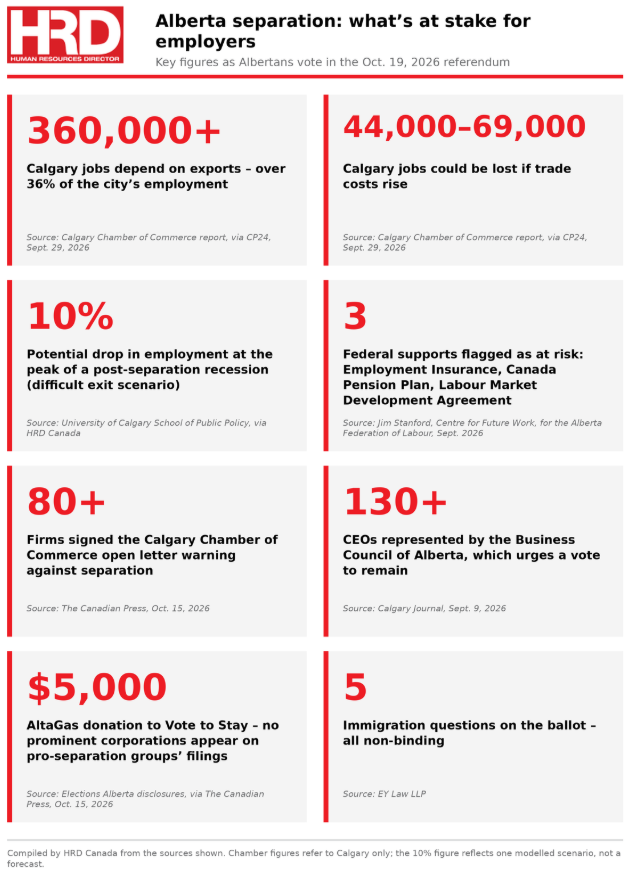
Alberta’s business community enters the Oct. 19, 2026 referendum on Alberta separation split in two: a few executives speaking on the record, and many more saying nothing. The stakes for employers are concrete. More than 360,000 Calgary jobs, or over 36% of the city’s employment, depend on exports to other provinces or countries, and 44,000 to 69,000 jobs could be lost if trade costs rise, according to a Calgary Chamber of Commerce report.
“It’s a mixed bag right now so far,” Bob Pickard, principal at Calgary-based Leadership Communication Inc., told The Canadian Press (CP). “Some leaders have spoken out with conviction. Others have remained quiet.” His firm is among more than 80 that signed a chamber open letter warning against a split.
Why are most CEOs silent on Alberta separation?
“It’s hardly surprising that a majority of CEOs are not speaking up,” Richard Leblanc, professor of governance, law and ethics at York University in Toronto, told CP. “You can alienate customers. You can alienate investors, so there’s more to be lost than gained, generally, by speaking up about a political matter.”
Adam Legge, president of the Business Council of Alberta, which represents more than 130 chief executive officers (CEOs), has acknowledged that some members hesitate to speak individually because their employees and customers include separation supporters. “It’s impossible to understate the uncertainty separation would create,” Legge said in a September 2026 council news release.
Deborah Yedlin, president and CEO of the Calgary Chamber of Commerce, told CP that companies wanted cover. “What we kept hearing was people wanted safety in numbers to sign,” she said. “I’m not sure that safety in numbers actually materialized the way we thought it would.”
Pickard was more blunt. “I think we’ve seen way too much passivity here,” he told CP.
The executives who went on record
Nancy Southern, CEO of Calgary-based Atco Ltd., signed the chamber letter, as did the heads of AltaGas Ltd., Keyera Corp., Capital Power Corp., BHE Transmission and AltaLink. John Whelan, CEO of Calgary-based Imperial Oil, posted on LinkedIn in September 2026, as reported by CP: “We believe a strong Alberta and a strong Canada go hand in hand.”
AltaGas gave $5,000 to the third-party advertiser Vote to Stay, according to Elections Alberta disclosures. No prominent corporations appear on pro-separation-referendum groups’ filings.
What would separation mean for HR leaders and employers?
A provincially commissioned University of Calgary School of Public Policy report found employment could fall 10% at the peak of a post-separation recession under a difficult exit, as detailed in HRD’s coverage of how Alberta separation could put one in 10 jobs at risk.
Economist Jim Stanford of the Centre for Future Work in Vancouver flagged Employment Insurance (EI), the Canada Pension Plan (CPP) and the Canada-Alberta Labour Market Development Agreement as federal supports at risk in a September 2026 report for the Alberta Federation of Labour (AFL). “Danielle Smith and the United Conservative Party (UCP) let the fires of separation burn for political reasons, and now working Albertans are being asked to carry the risk,” Stanford said, as reported by Canadian HR Reporter.
The referendum’s five immigration questions are non-binding, according to EY Law LLP. They sit alongside the Immigration Oversight Act, which received royal assent on May 14, 2026. Once proclaimed, it will require employers to register before hiring temporary foreign workers.
Inside workplaces, a pension and benefits lawyer previously advised employers to begin contingency planning now with investment, legal, and plan administration advisors.