Website: bankofcanada.ca
Head office address (Canada): 234 Wellington Street, Ottawa, ON K1A 0G9
Year established: 1935
Ownership structure: special federal Crown corporation; independent from the Government of Canada on policy matters; governed under the Bank of Canada Act
Target market/client profile: financial institutions, the Government of Canada, and Canada’s broader financial system; does not provide personal banking services to the public
Number of professional staff: over 2,000 employees
Canadian office locations: Ottawa (head office), Calgary, Halifax, Montreal, Toronto, Vancouver
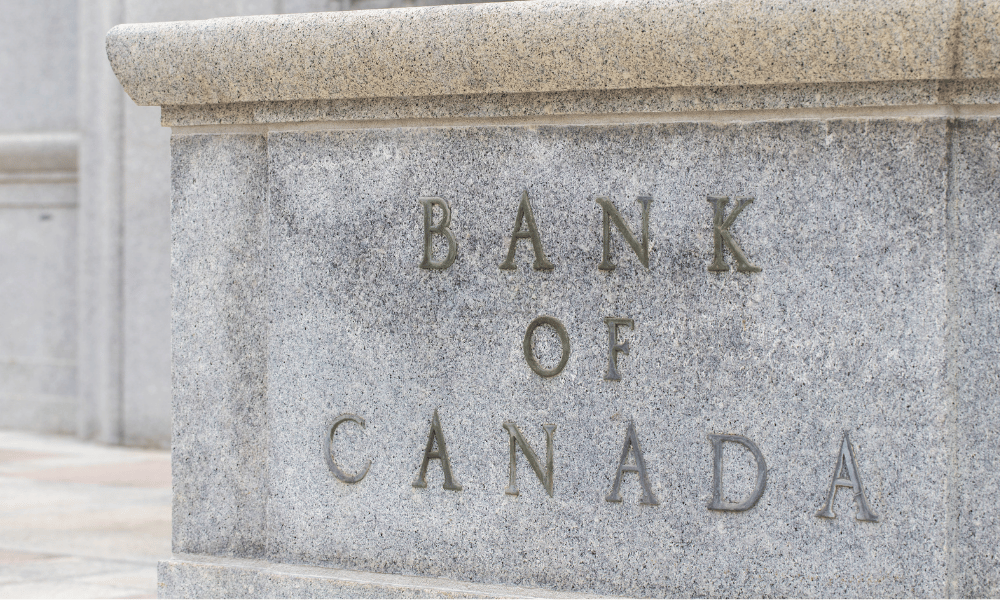
The Bank of Canada (BoC) is a federal Crown corporation and the country’s central bank. It operates independently from the federal government and sets rates to hit an inflation target it shares with Ottawa. The Bank posted net income of $181 million in the first quarter of 2026.
Also known as Banque du Canada, the Bank opened in March 1935, at the height of the Great Depression. Canada was then one of the last major economies without a central bank.
The federal government passed the Bank of Canada Act in 1934 to fill that gap. It brought on Graham Towers, a 37-year-old Royal Bank of Canada executive, as the institution’s first Governor.
The Bank launched with private shareholders in its early years. That structure was deliberate: Ottawa wanted monetary decisions kept separate from political pressure.
In 1938, the government bought out all private shares under Prime Minister William Lyon Mackenzie King. From there, the BoC became a special federal Crown corporation and has carried the same core mandate ever since.
In 1991, the Bank of Canada and the Government of Canada jointly adopted a formal inflation-targeting framework. That made Canada one of the first countries to anchor monetary policy to a stated price target.
The target sits at two percent, within a band of one to three percent. Both parties have renewed that agreement several times, and it remains the foundation of Canadian monetary policy today.
That framework faced its first major test in 2008 when the global financial crisis hit. The Bank of Canada cut the overnight rate sharply and used new monetary tools to keep credit flowing.
The 2020 COVID-19 pandemic forced rates to 0.25 percent and triggered the BoC’s first bond-buying program. A sharp rate-hiking cycle followed from 2022 onward as post-pandemic inflation peaked at 8.1 percent.
The BoC focuses on five main areas of responsibility that shape Canada’s monetary and financial system:
In recent years, the Bank of Canada expanded its regulatory work to include stablecoins and consumer-driven banking. Those additions show the shift toward digital payments and open finance in Canada’s financial system.
Tiff Macklem became the Bank of Canada’s 10th Governor in June 2020 for a seven-year term. His ties to the institution go back to 1984, and he had reached deputy governor level by 2004. Macklem’s academic background includes undergraduate studies at Queen’s University and graduate work in economics at the University of Western Ontario.
Macklem heads the Bank of Canada’s Governing Council, which sets the policy rate eight times a year:
The Bank of Canada’s Board of Directors oversees its planning, finances, risk management, and internal policies. The Deputy Minister of Finance sits on the Board but cannot vote on any decisions.
Canada’s chartered banks and credit unions rely on the Bank as their primary settlement institution and emergency lender. The BoC also manages the Government of Canada’s accounts, conducts bond auctions, and holds the country’s foreign exchange reserves. It has regional offices in:
The Bank of Canada also shares its economic analysis through the quarterly Monetary Policy Report and regional business surveys. In May 2026, Macklem described the current environment as a “more shock-prone world” in remarks to the financial community. He pointed to energy price spikes and trade uncertainty as the main risks to Canada’s inflation outlook.
External deputy governor Michelle Alexopoulos addressed business and HR audiences that same month on AI’s economic effects. She said the technology has so far lifted productivity rather than caused widespread job losses.
The Bank of Canada has earned recognition for its workplace programs and employee culture. Staff also contribute to community campaigns and broader economic education efforts.
The Bank of Canada supports staff-led networks for several employee groups. Staff also take part in annual United Way Centraide and HealthPartners campaigns.
On top of its policy work, the Bank takes part in economic outreach through published research and public forums. Its Sparks at Bank platform gives economists a space to share analysis on topics from labour markets to digital payments. The BoC also works with educational institutions and professional associations to promote understanding of its monetary policy role.
Marsh’s Pension Health Pulse shows median solvency at 132 per cent, but sponsors face tough calls on surplus and de-risking

Angus Reid found most of Canadians want their province to limit large data centre growth

Labour force participation hits a 29-year low, splitting economists before the October 28 rate call

MNP index finds 42% of Canadians fear AI will erode their employment or income

Nine in 10 plans sit at or above full funding, and only 11% are in deficit

Bond markets impose a premium and Canada gets swept up in it, KPMG Canada's chief economist says

While Canadian DB plans are well-funded, volatile rate conditions could erode surplus positions faster than many plan sponsors expect, one expert warns

Debt charges hit $20 billion for the period while the PBO questions the deficit path

Gasoline is up 22.8% year over year, and the Bank of Canada's next move matters for plan funding

Plans in surplus face a fresh repricing