A closer Canada-EU partnership could expand investment opportunities but is unlikely to reshape pensions or plan design anytime soon
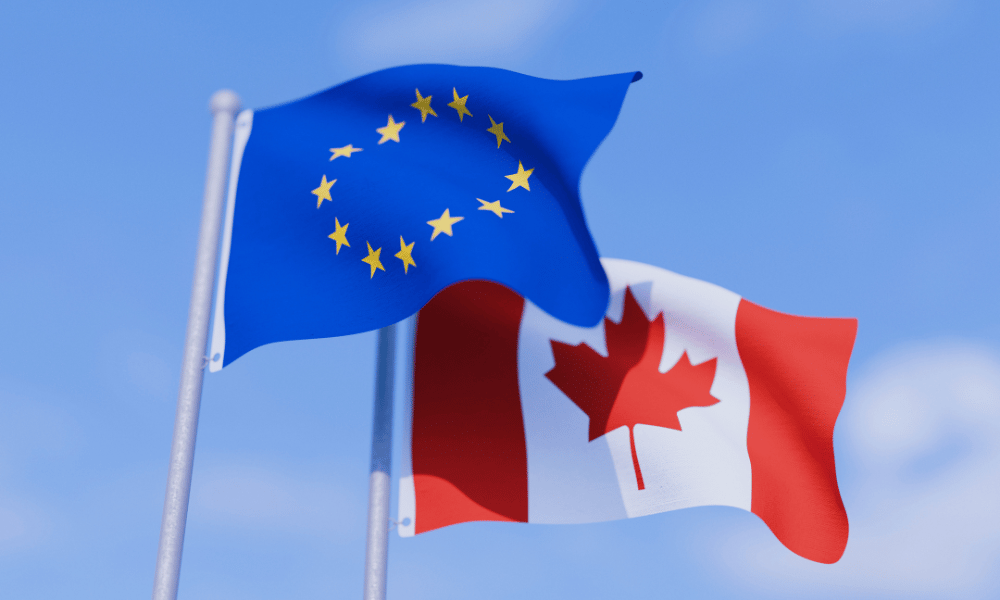
While Canada’s pursuit of a closer relationship with the European Union has generated significant political attention, pension and investment experts say the practical implications for pensions, benefits and institutional investment remain quite limited – at least for the time being.
For Rambod Behboodi, a trade and investment lawyer at Borden Ladner Gervais, based in Ottawa, the concept of associate membership lacks any formal legal basis within EU treaties, and its contours remain undefined.
“It would be premature to read anything into the board’s associate member because the thing doesn’t exist,” he said.
Canadian pension sovereignty untouched
Randy Bauslaugh, an independent semi-retired benefits and pensions lawyer, based in Toronto, underscored a closer relationship with Europe does not restrict Canadian sovereignty in any meaningful area. While he acknowledged that commercial incentives may encourage corporations doing business in the EU to comply with certain directives, when it comes to pensions and benefits, Canadian rules still govern.
“There’s no changes that would be required to the Canada Pension Plan or to the Quebec Pension Plan. There’s no changes to OAS. There’s no changes to the way in which we design, implement, govern, administer, private pension arrangements,” he added, underscoring that nothing in the proposed relationship would alter how employers structure health and welfare benefits, labour standards or human rights protections.
The one area where alignment may be necessary involves AI, data storage and cybersecurity, but he emphasized Europe is ahead on those fronts, and Canada would likely be moving in that direction regardless.
“There’s really nothing here that I think makes us do anything we’re not already doing, unless it’s for some sort of economic purpose of a particular corporation or person or entity wanting to do more business in the EU, and then they would have to follow those EU rules,” he added.
According to Bauslaugh, multinational employers can’t simply photocopy a Canadian pension plan and register it in the EU. He emphasized how tax rules, contribution deductibility, investment restrictions and registration requirements differ across jurisdictions, meaning plans must comply with local laws wherever they operate.
Investment opportunities, not pension reform
Even while the concept remains exploratory and that any arrangement would take time to settle, that lack of definition has not stopped speculation about what deeper economic ties could unlock.
Behboodi emphasized Canada already has a free trade agreement with the EU under CETA (Canada-European Union Comprehensive Economic and Trade Agreement) but the problem is that the framework hasn’t yet been fully ratified and its investor-state protections have not come into force, he said.
Before layering on new frameworks, he argued, the priority should be getting the Europeans comfortable enough to ratify what is already on the table.
Beyond trade agreements, he identified LNG and defense as two sectors where cooperation could deepen without disrupting other trading relationships. Europe continues to pay steep prices for liquefied natural gas, in part because it has not been able to break its dependence on Russian supply.
An investment framework that channels European capital into Canadian natural gas infrastructure could benefit both sides but would require long-term contracts that European countries have so far been unwilling to commit to, Behboodi noted.
“We're doing a lot of studies in various pipelines and such, but this [relationship] isn’t likely to be commercially viable unless we have long-term contracts with Europe, with European countries. At this point, they have not been willing to commit to,” said Behboodi.
Fauzia Babar, a Toronto-based investment consultant at People Corporation, said the real significance for the pension and benefits space lies not in the politics but in what follows from them.
“If Canada and the EU were to establish a deeper partnership focused on trade, investment, energy security, critical minerals, artificial intelligence, defense, and research collaboration, the result could be increased economic integration and cross-border capital flows between Canada and Europe,” she said.
From a defined contribution (DC) pension standpoint, however, she argued the significance lies not in political symbolism but in the economic and investment implications that could follow. A deeper partnership focused on trade, energy security, critical minerals, AI and defense could drive increased cross-border capital flows between Canada and Europe.
Most Canadian DC plans already hold European equities through the diversified international equity mandates embedded in their target date funds. A stronger Canada-EU relationship would reinforce the long-term investment case for those existing allocations rather than reshape them, Babar said.
Regulatory pressure falls on asset managers
On the regulatory front, Babar noted the more likely pressure point is sustainable finance regulation, where Europe is further ahead on climate risk disclosures and responsible investment frameworks. As Canadian financial institutions operate across both markets, she expects pressure to grow around aligning reporting standards, stewardship practices and ESG-related disclosures with European expectations.
But that burden would fall on asset managers first and not pension plans, she said. For DC plan sponsors, she does not anticipate any immediate regulatory changes stemming from the partnership.
“A deeper relationship will definitely increase opportunities to allocate capital towards European private markets and infrastructure projects, renewable energy initiatives, and technology investments,” Babar said, adding large Canadian pension funds have already been active in Europe, and greater economic alignment could accelerate those trends.
Still, she cautioned that deeper economic integration cuts both ways as European markets face a complex policy environment around energy security, defense spending, trade competitiveness and climate transition. While those dynamics may create investment opportunities, they can also introduce volatility and implementation risk for long-term investors.
Meanwhile, DC plan members, she said, would continue to depend on diversified portfolio construction and sound risk management rather than any presumed benefits of closer political alignment.
“DC plan sponsors should not expect significant changes to pension regulation or plan design,” she said. “The larger story is likely to be one of enhanced market access and investment diversification rather than pension reform, with the benefits emerging over years rather than immediately following any political agreement. We don’t anticipate a direct impact on pension regulation from this.”
While DC plans are easier to replicate across borders since the basic structure is similar, DB plans vary significantly from one jurisdiction to the next due to their funding deficits and actuarial liabilities, said Bauslaugh.
“You can have benefits that are fairly similar, but you still have to comply with local rules. It’s just like in Canada when you have a pension plan,” he said, comparing it to operating across Canadian provinces, where a single registered plan still needs separate provisions for Ontario, British Columbia, Quebec and elsewhere to meet each jurisdiction’s minimum standards. The EU adds another layer of complexity on top of that, but a closer partnership would not change the fundamental requirement to design around local regimes.
Closer ties won’t mean adopting EU social frameworks
As to whether a closer relationship means Canada adopting euro currency, Bauslaugh dismissed the prospect of that happening, noting he’s also unsure whether it would even be beneficial. He acknowledged mobility rights are similarly unlikely to change in any significant way.
He said EU social policies around wealth redistribution would not apply to Canada under any version of closer association and questioned whether the EU’s many directives function as binding legal rules or more as guidelines.
“If Canadian companies are doing business in the EU, yes, they will have to follow those sorts of policies and other directives, as long as it’s not going to change what we have to do in terms the way in which we regulate corporations or securities in Canada,” he said.