Joint statement covers digital trade, education and defence, but drops "associate member"
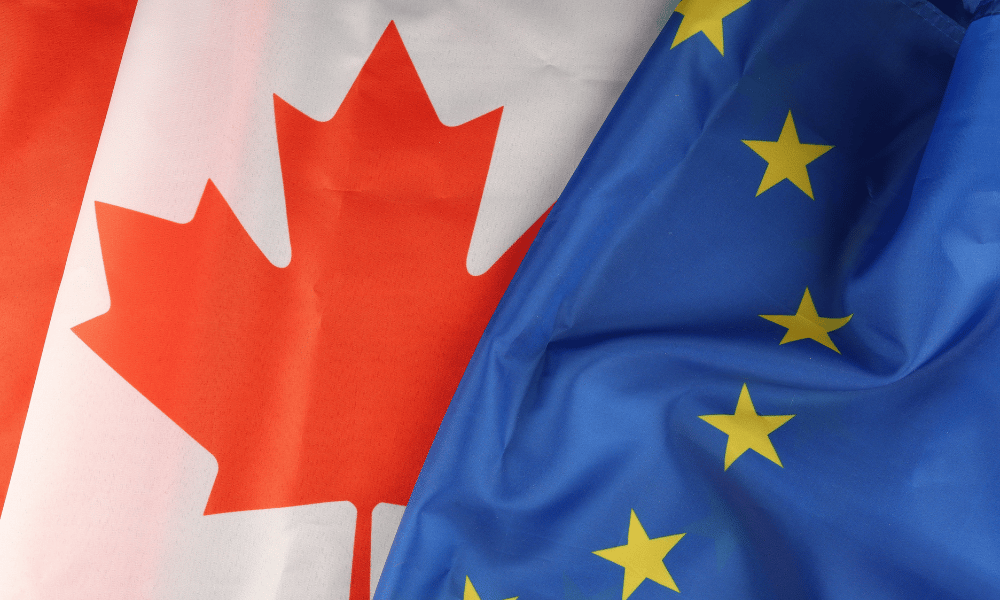
Canada and the European Union pledged to deepen their security, digital and education ties at a two-day summit that ended Friday, though EU members remain divided over what to call the relationship.
Prime minister Mark Carney, European Commission president Ursula von der Leyen and European Council president Antonio Costa released a joint statement Friday afternoon, CTV News reported. The leaders pointed to what they described as a destabilized international order.
The joint statement avoided the term “associate member,” using “ever closer association” instead. The two sides set the 2027 summit as the target for defining the arrangement, which falls short of full EU membership. CTV News reported that some countries, led by Germany, had bristled at the term.
The three leaders had all said they would like Canada to become an “associate member,” CTV News reported. Von der Leyen said Thursday: “We both want to bring our relationship to the highest level possible.” On Friday, Costa said: “Canada is by far the most European of the non-European countries.” Carney later said: “Our societies have been shaken by new storms.” Von der Leyen then said: “It is an association without accession.”
The statement announced the conclusion of substantive negotiations on a Digital Trade Agreement and welcomed Canada’s participation in a European high-performance computing initiative. Canada and the EU also pledged to negotiate an expanded Erasmus+ education exchange program, CTV News reported. Carney said Canada’s initial contribution to the EU’s planned €90 billion Ukraine loan will be €500 million, APA reported. Carney also announced Thursday that Ottawa will invest up to $1.6 billion in Toronto-based AI company Cohere. Canada is the only non-European partner in the EU’s SAFE defence procurement program.
Conservative leader Pierre Poilievre called the summit a distraction from the cost-of-living crisis. Conservative leaders also named the EU’s Carbon Border Adjustment Mechanism a priority for talks, saying the federal government assessed it could affect up to $2.8 billion in Canadian exports. Carney said negotiators are working on the mechanism and EU deforestation rules, but he did not provide specifics, CTV News reported.
Carney will attend EU council meetings in June at Costa’s invitation and hopes to confirm the terms of the arrangement by then. Von der Leyen also announced a spring meeting between the Canadian government and the full European Commission.
Benefits and Pensions Monitor reported that an EU diplomat told Politico that a one-year stock-take of Canada’s progress would consider whether it is exploring pension-fund investment with Brussels. The test also covers participation in Horizon Europe and Erasmus, undersea cables and critical raw materials stockpiling.
TD Economics has said Canadian banks, insurers, pension funds and asset managers have expertise in financing the energy, defence, critical mineral and digital projects Europe needs.
AFP reported that critical minerals used in batteries and wind turbines were a key focus. Europe sources them mostly from China, while Canada has plentiful stock but needs major infrastructure investment. The European Investment Bank is examining Canadian critical minerals projects first and is working toward a framework agreement, Wealth Professional reported. CPP Investments and PSP Investments co-hosted the federal Canada Investment Summit in September.