Ottawa urges 'buy Canadian' as pension billions keep flowing south

Canada’s public pensions now hold more in US assets than in their own backyard.
CBC News reports that Canada’s largest pension funds, together worth about $2.5tn, are heavily invested in US real estate, private equity and some of America’s biggest companies, despite the federal government’s “buy Canadian” response to US tariffs.
The Canada Pension Plan fund has reached a record $780.7bn, with 47 percent in American assets and just 13 percent in Canada.
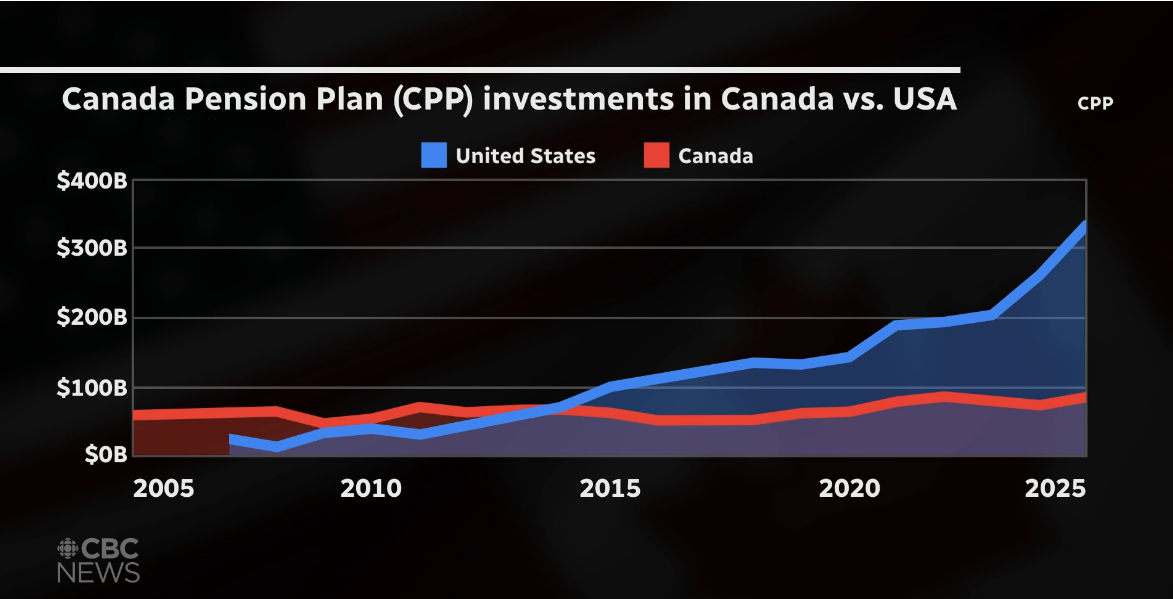
Source: CBC News
That exposure sits against a backdrop of strong performance.
Benefits and Pension Monitor reports that CPP Investments has generated more than $75bn in base CPP gains above actuarial expectations over the past three years, leaving the fund “substantially larger than projected.”
The combined base and additional CPP accounts delivered a 10‑year annualised net return of 8.4 percent, with cumulative net income of $543.4bn since 1999.
The latest review from the Office of the Chief Actuary of Canada, as reported by Benefits and Pension Monitor, assumes the base CPP will earn 4.05 percent above Canadian inflation and the additional CPP 3.53 percent in real terms over the next 75 years, and concludes both accounts remain sustainable at current contribution rates.
That record helps explain why experts resist calls to turn the funds into overt policy tools.
Kieth Ambachtsheer, director emeritus, Internation Centre for Pension Management, told CBC News that pensions like CPP should invest globally and focus on maximising returns, saying “when you measure it as to how we've actually done the last 10 20 years. It's pretty good.”
He also said funds such as CPP have “no obligation” to invest domestically and stressed, “There's no legal obligation at all.”
Still, Ottawa is trying to nudge, not order, capital back toward Canada.
François‑Philippe Champagne, the minister responsible, said in a CBC News report that he recently met with Canada’s top pension funds “to say, what can we do more together, respecting that they are independent, but at the same time, looking at opportunities.”
He said the government has created “a meeting point every quarter that we're going to be sitting together. We're going to be looking at opportunities looking at the kind of projects that could lead them to invest more in Canada.”
Champagne said that global investors see “a lot of opportunities around energy,” AI, electricity transmission, critical minerals, and refining in Canada.
He described the current period as “almost like the Golden Age now, for uh, our Pension funds also to be looking at Canada, because now there's more predictability,” and said Ottawa has put in place a more streamlined framework for large projects and is bringing more infrastructure deals online.
According to CBC News, the federal promise of major new infrastructure projects to respond to the US trade war is meant to give pension plans more investable domestic pipeline, not just rhetoric.
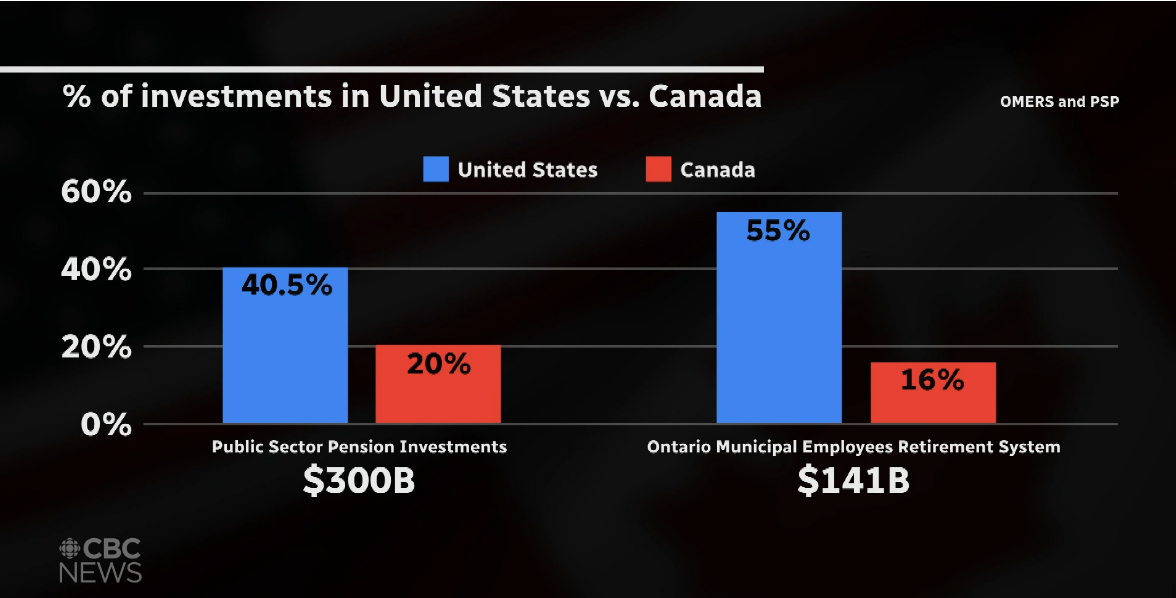
Source: CBC News
At the portfolio level, the big Canadian funds are not dumping US assets, but they are making targeted adjustments around currency and regional risk.
Benefits and Pension Monitor reports that recently, Ontario Teachers’ Pension Plan has cut its US dollar and US Treasuries exposure while keeping the US as a core market.
President and CEO Jo Taylor told Bloomberg Television at the 2026 World Economic Forum in Davos that the fund is doubling down on private markets and selective AI‑related investments.
He said Ontario Teachers’ “thought we were a little over exposed to the dollar and actually, probably a little over exposed to US treasuries,” and trimmed both in the first quarter of last year after he “saw personally that there was probably more risk of a deflationary dollar.”
According to Benefits and Pension Monitor, the US still makes up roughly 30 percent of the portfolio and “is always going to be an important territory for us for further Capital.”
The Toronto Transit Commission Pension Fund, which manages about $9.2bn, has been adding to Europe “most significantly” while keeping roughly 40 percent of assets in the US and 30 percent in Canada.
Chief investment officer Andrew Greene said the fund is “relatively light” Europe and already holds real estate, infrastructure and private credit in the region.
He also flagged uncertainty created by Trump’s tariffs and pressure on the US Federal Reserve, even as the rule of law still supports doing business there.
UBC Investment Management is taking a different route.
Benefits and Pension Monitor reports that it oversees about $7bn for the University of British Columbia and is leaning into Asia for diversification.
Chief executive Dawn Jia said there is “growing concern in markets right now about the possibility of US dollar depreciation, and those concerns are not without merit,” but stressed the fund will not overreact to short‑term politics.
Instead, she said the plan is seeking exposure “to a wider set of regional economies — particularly Asia Pacific.”
Currency risk is now central to these decisions.
Benefits and Pension Monitor, citing Bloomberg, notes that Ontario Teachers’ move away from the greenback reflects concern about a “deflationary dollar.”
As per the Financial Post, former Healthcare of Ontario Pension Plan chief executive Jim Keohane, now on the board of Alberta Investment Management Corp., warned that “if the US dollar weakens due to the political uncertainty, it can overwhelm the returns you earn on US assets.”
According to the same Financial Post report, DBRS Morningstar said Canadian pensions have shifted away from US‑dollar borrowing, with US‑dollar issuance at a six‑year low and borrowing in other currencies rising to support global strategies.
The question is less “US or Canada?” and more how to balance global return maximisation, currency risk, and domestic opportunity in a world where Canadian pensions are being asked to be both world‑class investors and nation‑building partners—without a change in their legal mandate.