Money worries are one of the most common sources of everyday stress

This article is sponsored by BMO Global Asset Management
With enough financial decisions competing for your attention, having a workplace savings plan that’s easy to join, simple to understand and straightforward to manage can help you focus on what truly matters: building your savings.
These plans can take many forms, including Group Registered Retirement Savings Plans (Group RRSPs), Deferred Profit-Sharing Plans (DPSPs), and Tax-Free Savings Accounts (TFSAs). While the names may vary, each type of workplace savings plan is designed to help employees build long-term savings through simple and accessible investing options offered through their employer. Depending on the plan, employers may also contribute to an employee's account or match a portion of their contributions, helping savings grow even faster.
Ultimately, whether your goal is retirement, a major life milestone, or simply building stronger financial habits, understanding how your workplace savings plan works can help you make the most of one of the most valuable benefits your employer offers.
So, what does that actually look like in practice? Here’s a plain-language walkthrough of what the numbers mean, how your portfolio takes care of itself, and why the fees you’re not paying matter just as much as the ones you are.
What “lower fees” mean for your paycheque
When it comes to a workplace savings plan, every dollar that goes into fees is a dollar that stops working for you: it doesn’t grow or compound, and it doesn’t show up in the future as part of your retirement income.
Picture two 30-year-old coworkers: Sara and Dan. Both start contributing CAD $300 a month to their workplace savings plan, earning the same average annual return of 6% before fees. The only difference is what they pay to invest: Sara’s plan charges an annual fee of 0.35%, Dan’s charges 2%. While that gap might look insignificant on a statement, over a 35-year career, that seemingly minor difference can mean a gap of well over $100,000 in Sara’s favour.5
That’s the rationale behind BMO|LINK’s lower-fee, ETF-based plans: every basis point you don’t pay in fees or commissions is a basis point that stays invested, compounding year after year and quietly working toward a meaningfully better retirement outcome for your future self.
Getting started takes minutes, not meetings
Joining the BMO|LINK Workplace Savings Platform is designed to be fast and effortless—the kind of streamlined process that gets you engaged with your plan from day one.
Your account typically comes pre-filled with details from Human Resources, so you’re not starting with a blank application—just a quick review and confirmation, and you’re ready to begin. From there, a short questionnaire assesses your investment goals, your comfort with risk, and your timeline, and then recommends one of the five ETF portfolios best suited to your risk profile.6
ETF portfolios for your group savings plan
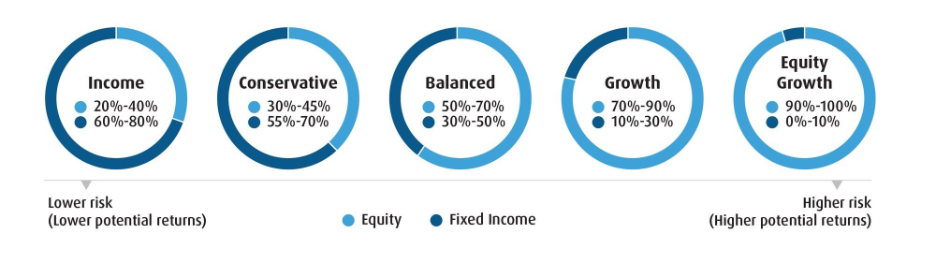
Source: BMO Financial Group. All investments involve risk. The value of an exchange-traded fund (ETF) can go down as well as up and you could lose money. The risk of an ETF is rated based on the volatility of the ETF’s returns using the standardized risk classification methodology mandated by the Canadian Securities Administrators. Historical volatility doesn’t tell you how volatile an ETF will be in the future. An ETF with a risk rating of “low” can still lose money. For more information about the risk rating and specific risks that can affect an ETF’s returns, see the ETF facts and/or prospectus of the relevant ETF.
From there, it’s simply a matter of choosing how much to contribute—a task you can automate so saving happens without a second thought. And if any questions come up during onboarding, a LINK representative is available by online chat or phone to help.
Another task off your list: your ETF portfolio automatically rebalances each quarter to stay aligned with your risk profile, while dividends are automatically reinvested—keeping your money working for you in the background, without any ongoing effort on your part.
Understanding your workplace savings dashboard
Once you’re set up, your retirement savings journey has already started—and you can track your balance, your funds, and your progress anytime. Here’s what the key terms mean:
Total Portfolio Value shows how your money is spread across asset classes and different types of investments—cash, fixed income, and equities—based on your risk profile and how many years you have until retirement. Someone in their late twenties will typically see a very different mix than someone five years from retiring, and that’s by design.
Total Plan Return shows how your investments have performed over different periods. You can view your return for the previous month, three months, six months, one year, or since inception. Because markets move up and down constantly, what matters most for a retirement account is the long-term trend—not short-term swings.
Annualized Fee is the cost of your plan, expressed as a yearly percentage. With an ETF-based plan, this number tends to be small and, just as importantly, transparent—you’re not left guessing how much your investment is actually costing you.
Annualized Yield shows the income your investments have generated, expressed as a percentage and annualized based on the most recent period. It can include income such as interest and dividends and gives you a sense of the portfolio’s income-generating potential.
As your life changes, so can your plan
As your workplace savings plan runs in the background, there are a few key moments when it’s worth checking in and making an adjustment:
- You get a raise: It’s a natural time to increase your contribution rate—even by a percentage point or two—before the extra income gets absorbed elsewhere.
- You get married or have a child: It may be a good time to review your beneficiary designations and risk profile to make sure they still reflect your wishes and circumstances.
- You’re nearing retirement: As your time horizon shortens, your asset mix would typically shift to reduce risk and protect the savings you’ve built.
None of these require a phone call, an advisor meeting, or a stack of paperwork. In most cases, a few minutes online is all it takes to update your profile and have your portfolio adjust accordingly.
The bottom line
The best workplace savings plan isn’t necessarily the one with the most features. It’s the one you’ll actually use. And by making it easy to join, simple to understand, and effortless to maintain, BMO|LINK helps employees turn saving for the future into a habit rather than a chore.
That consistency, combined with transparent, lower-fee ETF-based investing and a digital-first platform that does the heavy lifting, can add up to something much bigger: greater confidence in your financial future.
Sources
1 BMO Financial Group, “From cost drag to cost smart: How ETFs are reshaping group retirement,” April 15, 2026.
2 BMO Financial Group, “What you pay matters: Understanding ETF-based group plan fees,” May 28, 2026.
3 BMO Financial Group, “Why ‘digital-first’ is redefining group retirement plans,” July 6, 2026.
4 Lower fees tend to be charged on exchange-traded funds (ETFs) than many other investments, including mutual funds.
5 For illustrative purposes only.
6 Risk profile: One’s risk profile is comprised of risk tolerance (i.e., willingness to accept risk) and risk capacity (i.e., ability to endure potential financial loss).
Disclaimers
This content is sponsored by BMO Global Asset Management (BMO GAM). Benefits and Pensions Monitor was compensated by BMO GAM for this article. Benefits and Pensions Monitor is an independent organization and is not affiliated with BMO GAM.
The BMO|LINK Workplace Savings Platform is a software-as-a-service platform managed by LINK Investment Management Inc. (“LIM”). LIM is a corporation incorporated under the laws of Canada and has its head office in Calgary, Alberta. LIM provides business solutions for workplace savings and pension plans, using innovative, fully digital, software-as-a-service business solutions to empower plan administrators and plan members with simple, affordable and efficient plan management. LIM has retained LINK Plan Management Inc. (“LPM”), a wholly owned subsidiary of LIM, to act as the full discretionary portfolio manager to employees who open accounts with LPM under the BMO|LINK Workplace Savings Platform. LPM is a corporation incorporated under the laws of Canada and has its head office in Calgary, Alberta. It is registered as a portfolio manager in Alberta, British Columbia, Manitoba, New Brunswick, Nova Scotia, Ontario, Quebec, and Saskatchewan. Its principal regulator is the Alberta Securities Commission. LPM’s registration is subject to terms and conditions related to its use of an online “know your client” process for its operations, which restricts LPM from using margin, short selling or a leveraged investment strategy in its clients’ managed accounts, and restricts its clients’ managed accounts to only be invested in mutual funds, including exchange traded funds that are not commodity pools and do not use short selling or a leveraged investment strategy and cash and cash equivalents. LIM and LPM retained BMO Asset Management Inc. (“BMOAM Inc.”) as its marketing representative and agent to market the administrative services provided by LIM in respect of the BMO|LINK Workplace Savings Platform. LPM has retained BMOAM Inc. as its sub-advisor to provide investment advisory services to LPM in respect of the accounts. BMOAM Inc. is a wholly owned subsidiary of Bank of Montreal, and Bank of Montreal holds a minority ownership position in LIM. Under the BMO|LINK Workplace Savings Platform, LPM will invest in investment products manufactured and/or advised by BMOAM Inc., including BMO ETFs (collectively, “BMO Products”). To the extent that LPM makes BMO Products available to its clients using the BMO|LINK Workplace Savings Platform, LPM will do so in compliance with its current policies and procedures and applicable laws and regulations, including LPM’s duty to resolve any conflicts of interest in the best interests of its clients. LPM, as portfolio manager to employees who open accounts, is ultimately responsible for investment decisions made in connection with the BMO|LINK Workplace Savings Platform. Questions regarding the BMO|LINK Workplace Savings Platform or any investment decisions or advice provided by LPM should be directed to LPM.
This article is for information purposes only. The information contained herein is not, and should not be construed as investment, tax or legal advice to any party. Particular investments and/or trading strategies should be evaluated and professional advice should be obtained with respect to any circumstance.
The viewpoints expressed by the authors represent their assessment of the markets at the time of publication. Those views are subject to change without notice at any time. The information provided herein does not constitute a solicitation of an offer to buy, or an offer to sell securities nor should the information be relied upon as investment advice. Past performance is no guarantee of future results.
This material is for information purposes only. The information contained herein is not, and should not be construed as investment, tax or legal advice to any party. Particular investments and/or trading strategies should be evaluated and professional advice should be obtained with respect to any circumstance.
Any statement that necessarily depends on future events may be a forward-looking statement. Forward-looking statements are not guarantees of performance. They involve risks, uncertainties and assumptions. Although such statements are based on assumptions that are believed to be reasonable, there can be no assurance that actual results will not differ materially from expectations. Investors are cautioned not to rely unduly on any forward-looking statements. In connection with any forward-looking statements, investors should carefully consider the areas of risk described in the most recent simplified prospectus.
Commissions, management fees and expenses all may be associated with investments in exchange-traded funds. Please read the ETF Facts or prospectus of the BMO ETFs before investing. Exchange-traded funds are not guaranteed, their values change frequently and past performance may not be repeated.
For a summary of the risks of an investment in the BMO ETFs, please see the specific risks set out in the BMO ETF’s prospectus. BMO ETFs trade like stocks, fluctuate in market value and may trade at a discount to their net asset value, which may increase the risk of loss. Distributions are not guaranteed and are subject to change and/or elimination.
BMO ETFs are managed by BMO Asset Management Inc., which is an investment fund manager, a portfolio manager, and a separate legal entity from Bank of Montreal.
BMO Global Asset Management is a brand name under which BMO Asset Management Inc. and BMO Investments Inc. operate.
“BMO (M-bar roundel symbol)” is a registered trademark of Bank of Montreal, used under licence.