Economists expect an easing bias on Wednesday as 50% US tariffs on $28 billion of Canadian goods darken the growth outlook
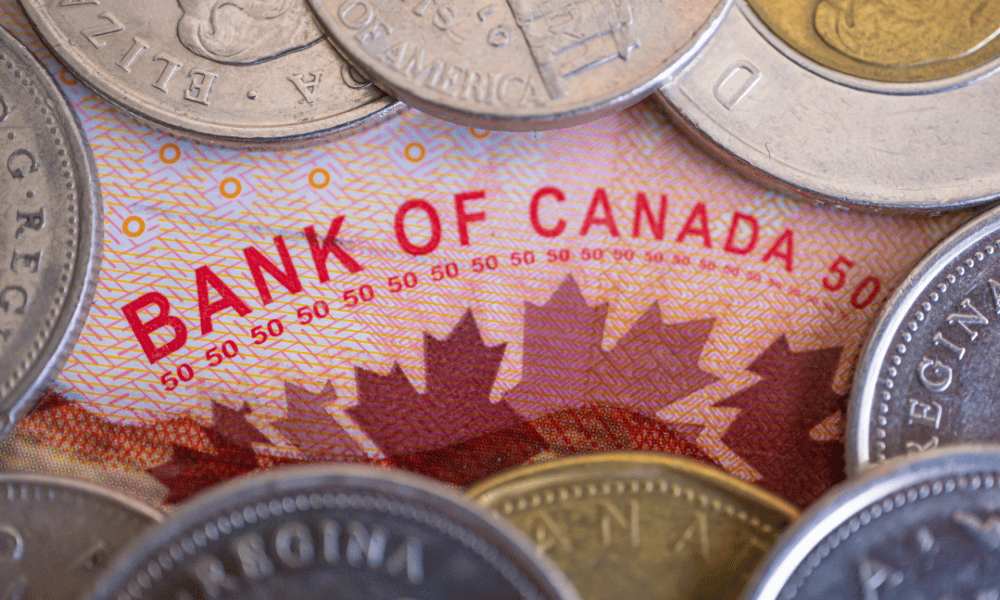
Canada's counter-tariffs on US goods take effect on September 8, six days after the Bank of Canada's next interest rate announcement.
The Canadian Press reported that the US imposed 50 percent tariffs on roughly five percent of Canadian exports on August 22, and the Financial Post put the value of the affected goods at $28bn.
Reuters reported that Prime Minister Mark Carney walked away from negotiations the same day and announced retaliation alongside support measures for affected businesses.
All 35 economists surveyed by Reuters expect the overnight rate to stay at 2.25 percent on September 2.
Odds of a seventh straight hold sat near 94 percent as of Monday morning, the Canadian Press reported, citing LSEG Data & Analytics.
Wealth Professional has reported that the rate has held at 2.25 percent since October 2025.
"The bank has been always hesitant to make a move on rates that they might have to retrace later, because things are so uncertain," Tony Stillo, director of Canada economics at Oxford Economics, told the Canadian Press.
Inflation hit three percent in July, the top of the 1 to 3 percent target range, according to Reuters, with stable core measures pointing to weak demand.
Statistics Canada data released Friday showed the fastest second-quarter growth in more than three years, and Wealth Professional put the annualised figure at 3.3 percent, with gains across nearly 90 percent of the economy.
CIBC Capital Markets managing director and chief economist Avery Shenfeld told Reuters that "In the near term, any concerns over inflation ahead are roughly offset by risks to economic growth from trade tensions, leaving the Bank in a watchful-waiting stance."
Reuters reported its poll sees a hold until the third quarter of next year and a move to 2.50 percent in the fourth quarter of 2027.
National Bank of Canada strategists Taylor Schleich and Ethan Currie wrote in a Monday note carried by the Financial Post that "Given recent developments, the likelihood of rate cuts has clearly grown."
The same note estimated 100,000 to 130,000 Canadian jobs at risk if the tariffs remain, per the Financial Post, which also reported that Finance Minister Francois-Philippe Champagne would unveil support measures modelled on COVID-19 era programs.
BMO chief economist Doug Porter, in an interview with the Canadian Press, said the growth outlook now dominates.
"The trade battle really does darken the growth outlook. Unless that's resolved, I think that's really what they've got to focus on, first and foremost," Porter said.
Stillo told the same outlet he expects Governor Tiff Macklem to signal an easing bias.
Falling yields lift the value of pension promises.
A previous Wealth Professional report, citing Mercer, put the median solvency ratio of Canadian defined benefit plans at 128 percent as of June 30, up five percentage points on the quarter, with 89 percent of plans at or above full funding.
That report credited investment returns, partly eroded by a dip in interest rates and by sponsors taking contribution holidays.
The US Federal Reserve is running a tighter setting.
Its implementation note of July 29 directed the Desk to maintain the federal funds rate in a target range of 3.5 to 3.75 percent effective July 30.
Nine members agreed to that range, the Fed's minutes of the July 28 to 29 meeting show, with the interest rate on reserve balances held at 3.65 percent.
The next Federal Open Market Committee meeting is set for September 15 and 16.